

Exhale
Zambia, Africa
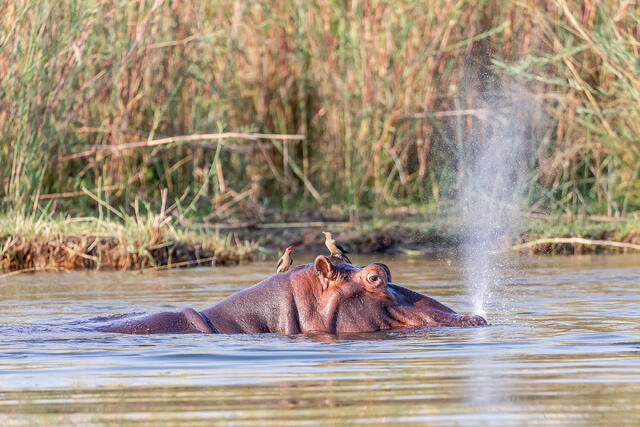
With a pair of red-billed oxpeckers along for the ride, a hippopotamus exhales as it swims in the Zambezi River near Zambia.
Hippos are adapted to an aquatic environment. The dorsal position of their nostrils facilitates surface breathing while the body is submerged, and the closed resting position of the nostrils protects the respiratory tract from water intrusion. They also possess nasal plugs that seal the nasal cavity, constituting a second mechanism to prevent water entry. These factors allow a fully submerged to close its nostrils, while also folding back its ears to prevent water entry. They can stay underwater for as long as five or six minutes. When they come up, they exhale loudly, snorting and hissing as air blasts out of their nostrils.
Oxpeckers are endemic to the savanna of Sub-Saharan Africa. They possess wide bills, short legs, stiff tails, and have three sharp claws facing forward and one facing backward. Oxpecker feet are strong and excellent for clinging to surfaces.
The hippo and the oxpecker are thought to have a mutual relationship, with both the hippo and oxpecker benefitting. The birds remove ticks, flies and other insects from the bodies and/or wounds on these animals. But this mutual relationship has also been questioned, and the oxpeckers could be considered parasites instead. Oxpeckers have been observed to open new wounds and enhance existing ones in order to drink the blood of their host. And most of the ticks they remove have already fed on the hosts blood, thereby minimizing the benefits of removal.
Photo © copyright by Dr. Edward Mikol.
Photo Prints
Metal Prints
Canvas Prints
Acrylic Prints