Grebe Mating Season: Early Action
Spring has arrived, and with it comes a host of mating behaviors and rituals as animals pair off to reproduce. Birds, in particular, go through some of the most complex and impressive courting routines. Those performed by Western and Clark’s grebes are second to none.
First, some introductions. Western Grebes and Clark’s Grebes are so similar in plumage and behaviors that they were considered to be color phases of the same species - the Western Grebe. Clark’s Grebe was considered a “light morph” of the Western Grebe, but by 1985 scientists and taxonomists realized that the two were separate species. They were known to rarely interbreed, even if they live in close proximity, and they make different calls. They also have substantial DNA differences so it made sense to divide them into two different species.
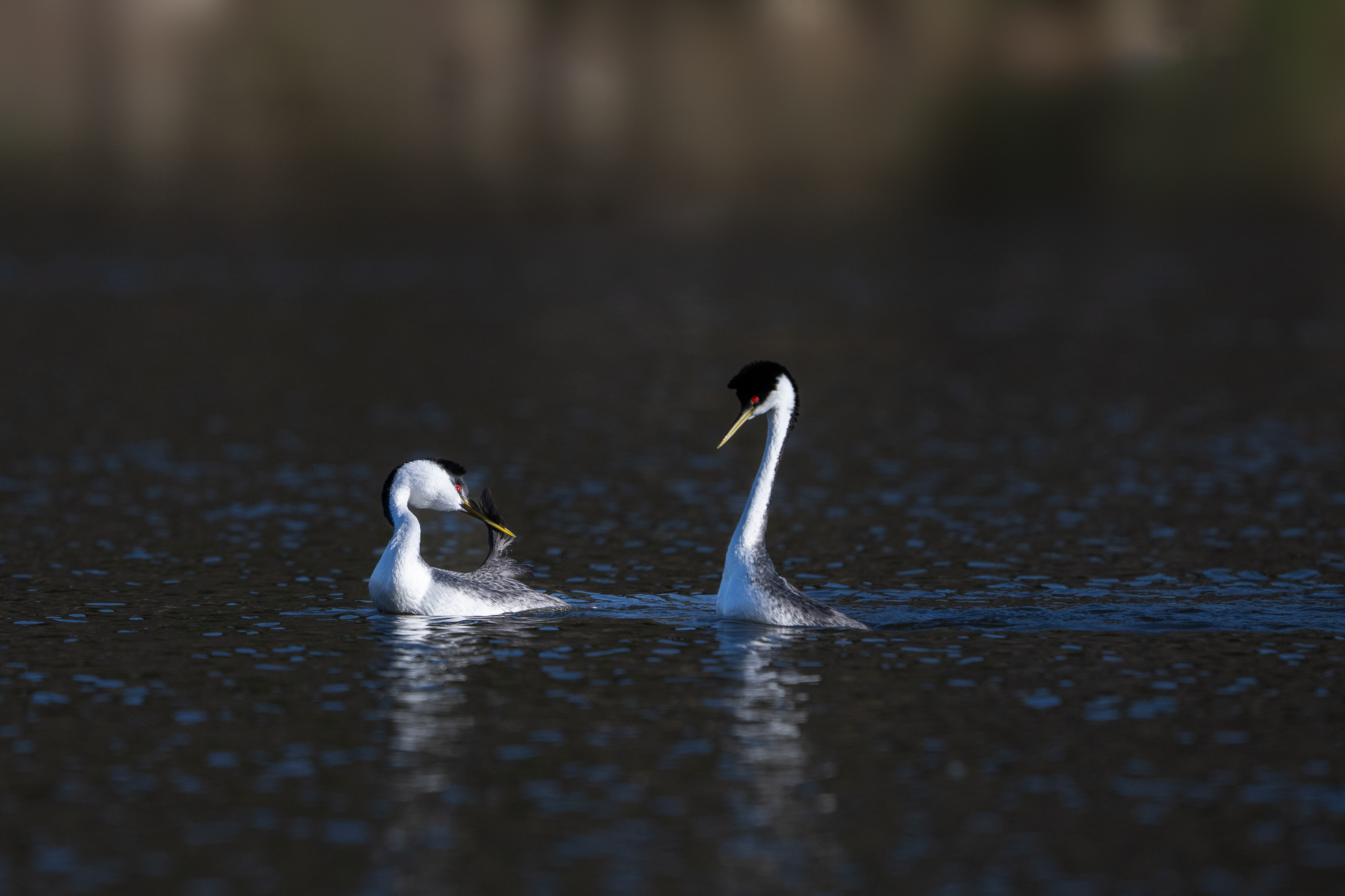
To distinguish them, note that the bill of the Clark’s Grebe is brighter yellow-orange, compared to the yellowish-green bill of the Western. The Western Grebe tends to have less white on the flanks and wings than the Clark’s. But the easiest way to tell them apart is that the black crown of the Western Grebe extends below the eye, while it does not in the Clark’s.
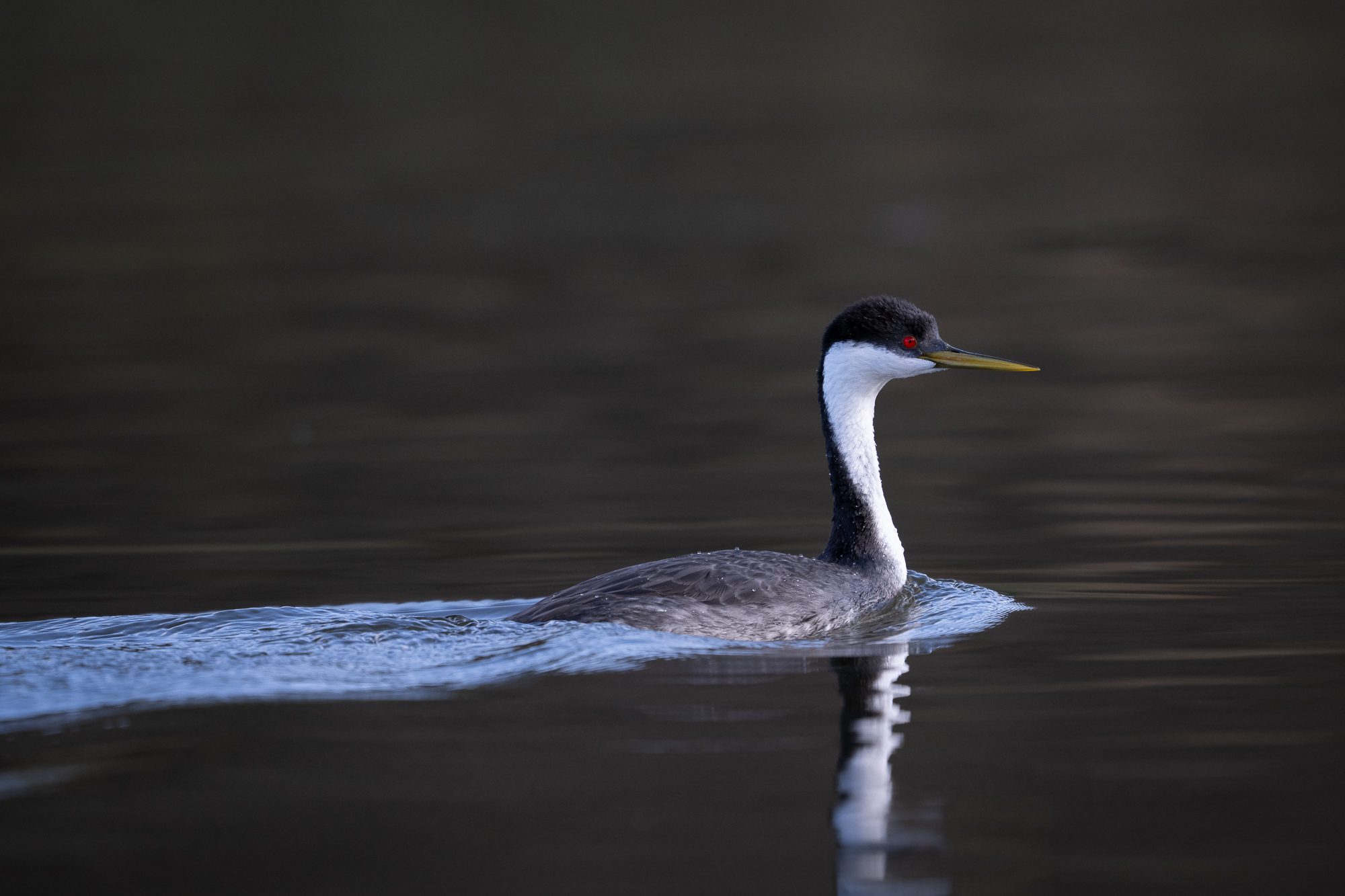
Western Grebe
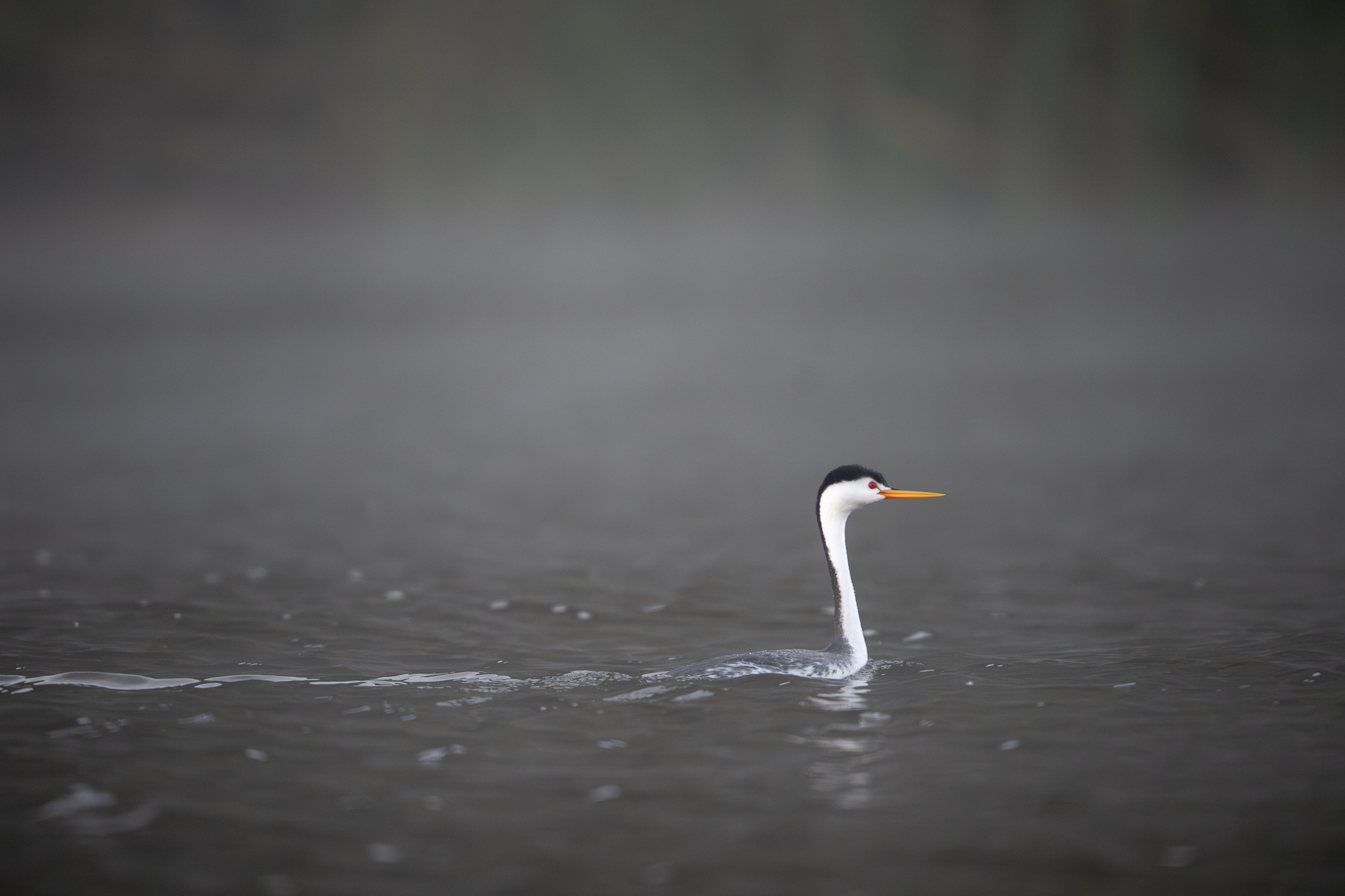
Clark's Grebe
Grebe courting is characterized by two main behavior progressions, called “ceremonies”, because each involves a specific set of behaviors performed in sequence. The first is called “the rushing ceremony”, when the grebes are choosing a mate. This is followed later in the season by “the weed ceremony”, which occurs after the grebes have paired off.
Advertising
Early in the season, grebes swim about restlessly, searching the still waters of a lake for a mate. As they do, they call out loudly, which is termed advertising. On hearing the call, interested birds of the opposite sex respond by approaching and advertising in reply.
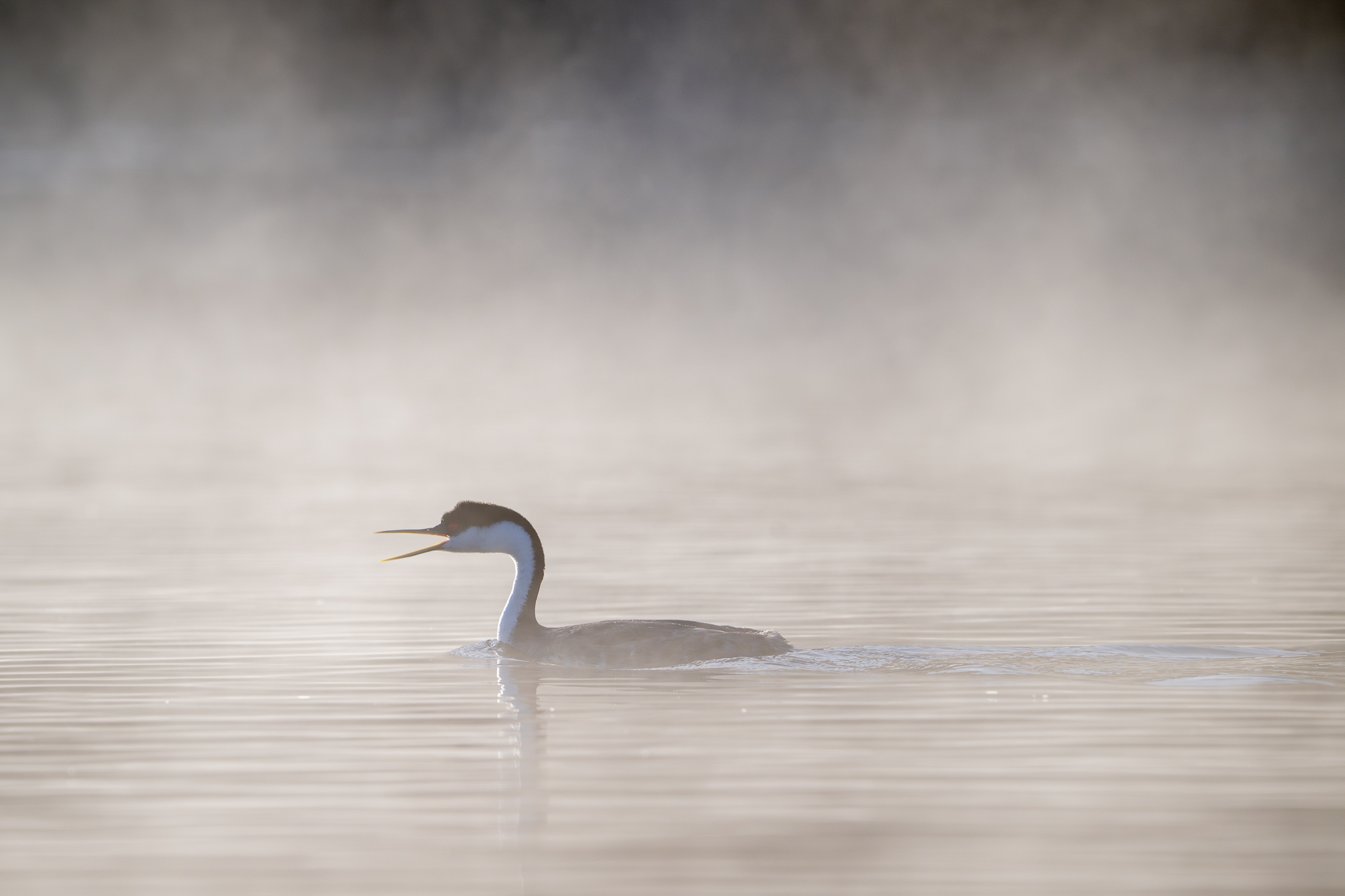

Birds then approach one another, sometimes in groups of three or more.
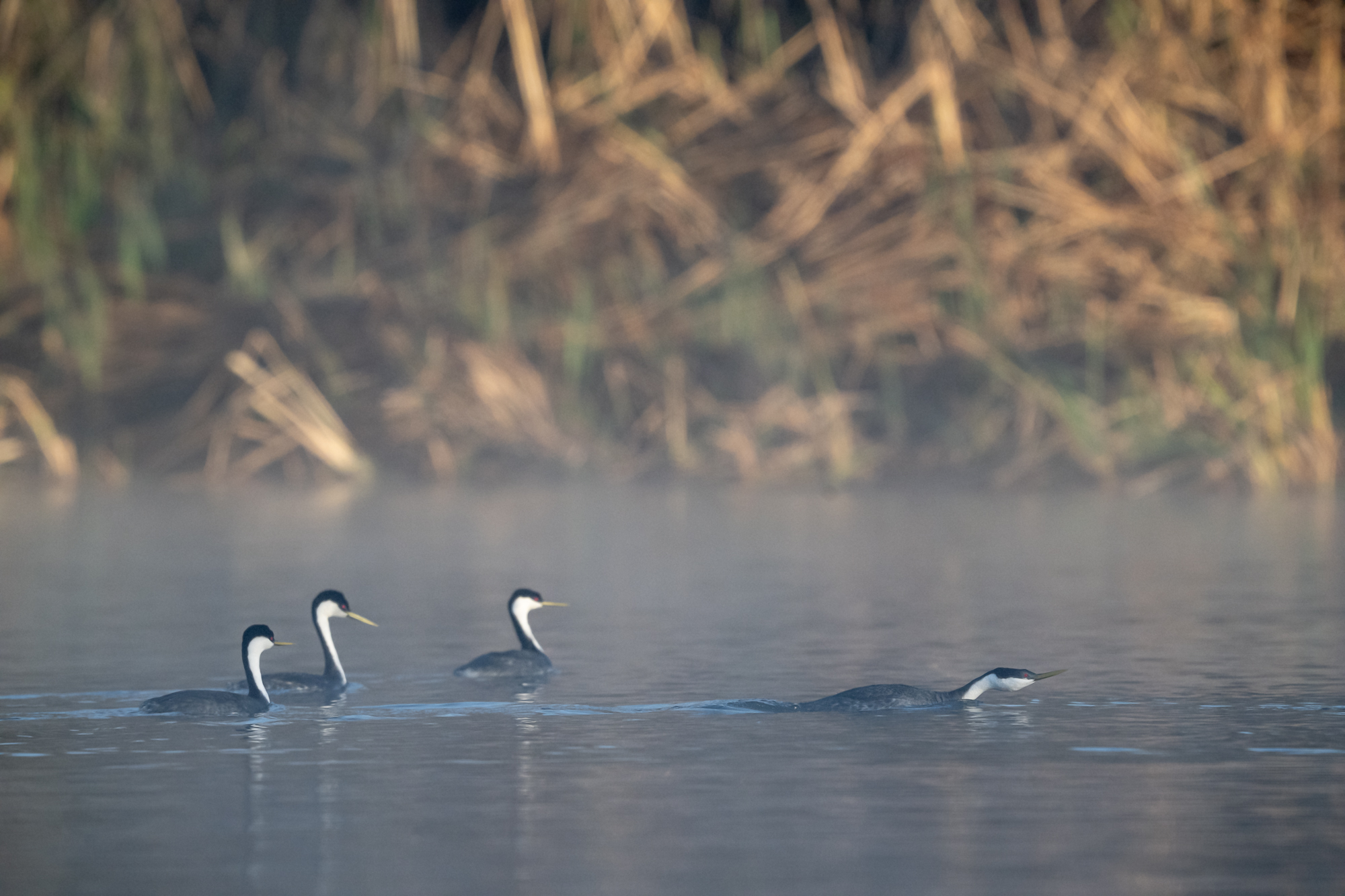
Rachet-pointing
The courting then progresses to ratchet-pointing, in which birds point their bills toward each other, lower themselves in the water, then give a grating, ratchet-like call with crest raised and throat distended. (Note the Clark's Grebe in between two Western Grebes)

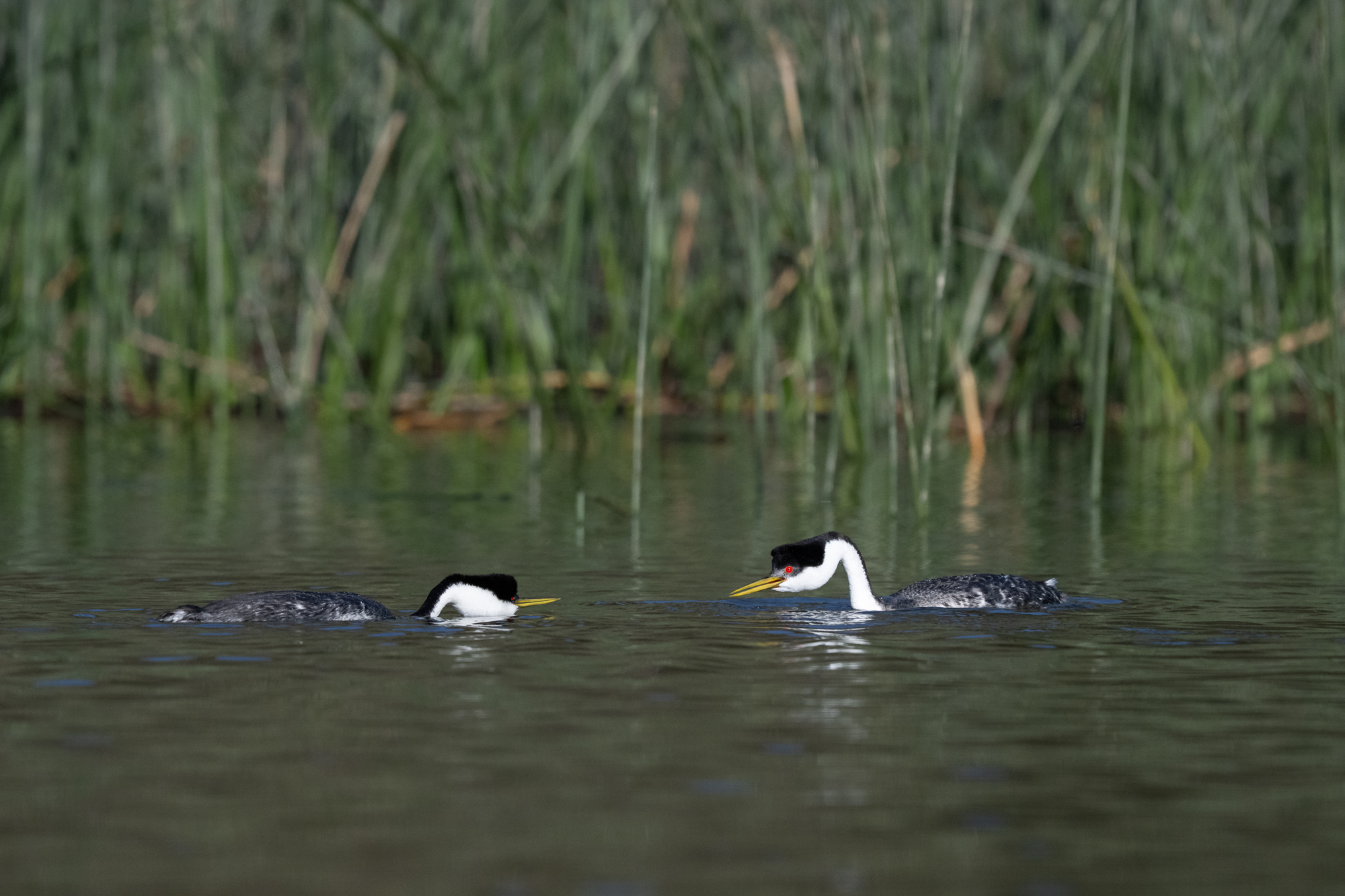
Dip-shaking
This involves dipping the bill and head into the water, then raising up and shaking the head from side to side. This involves a low-neck posture and a conspicuous water splash.
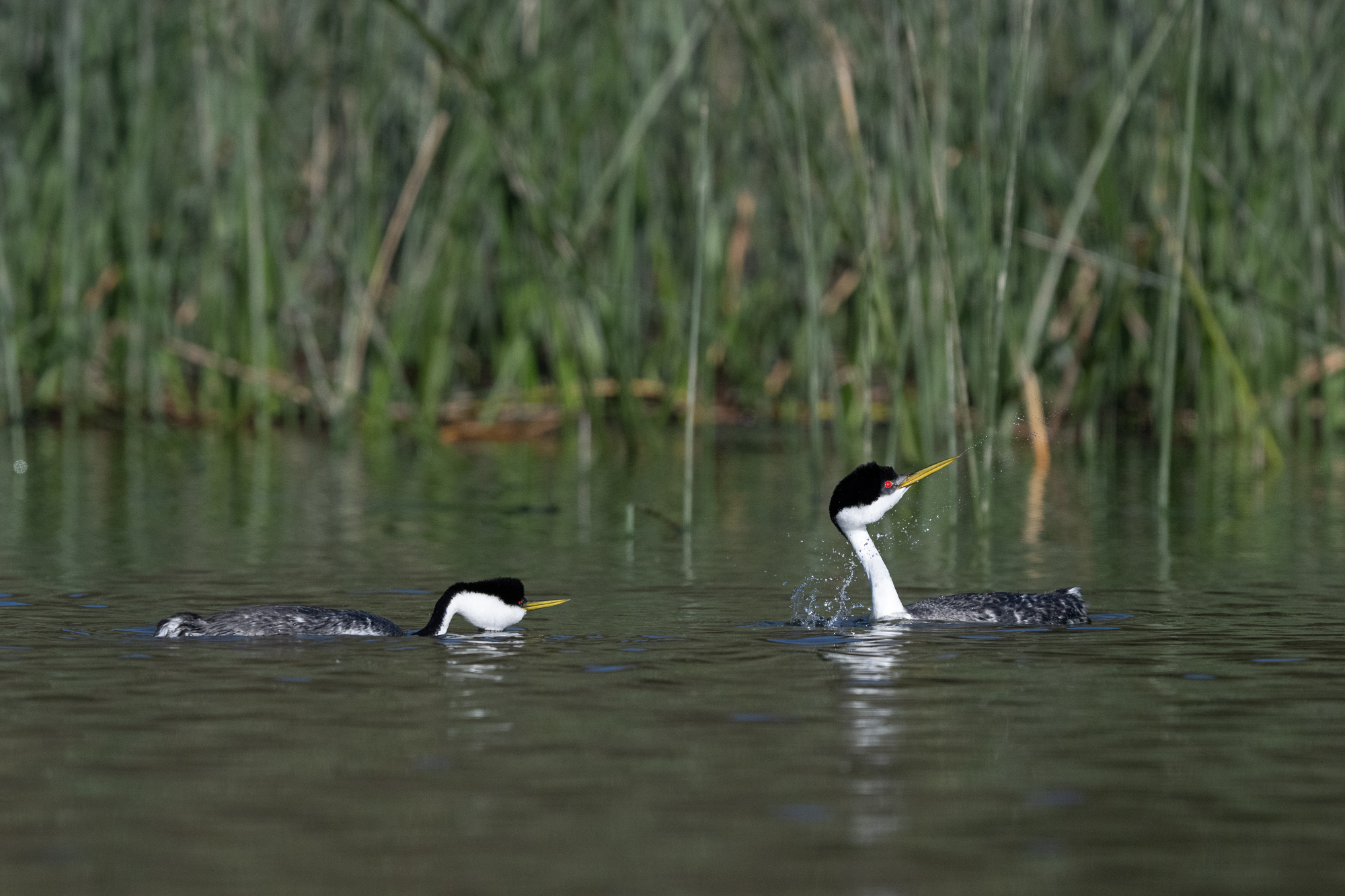
Rushing
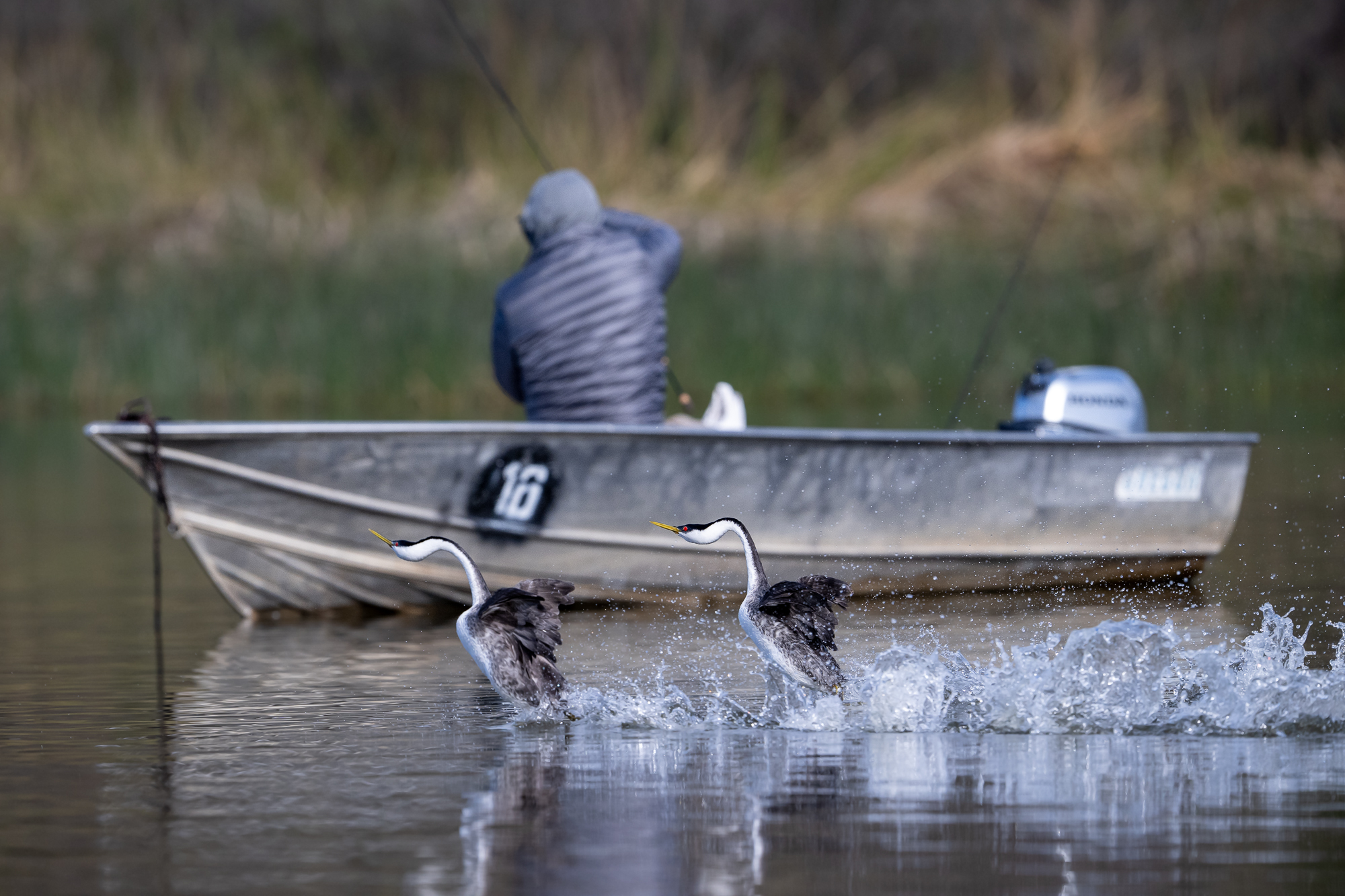
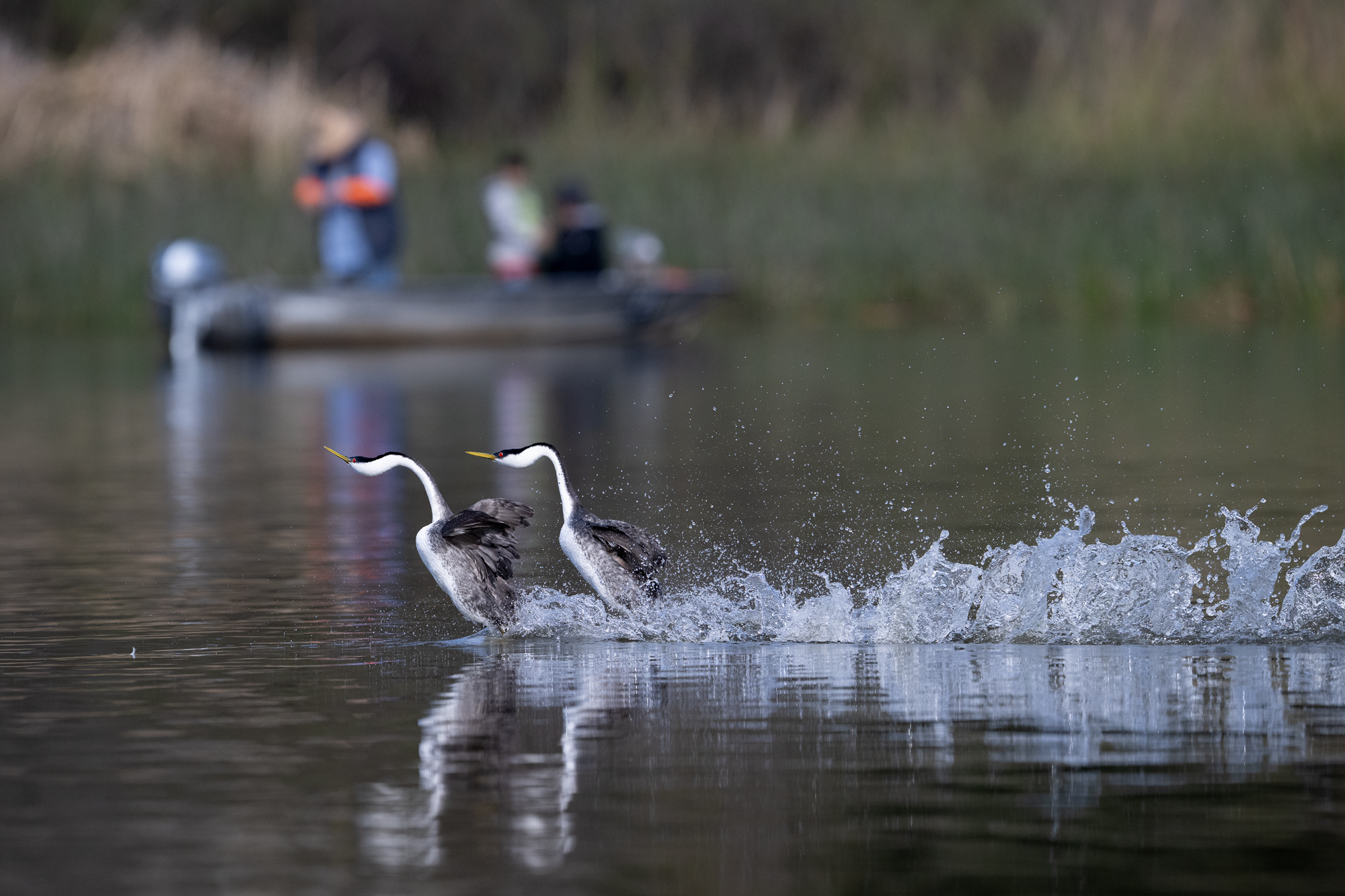
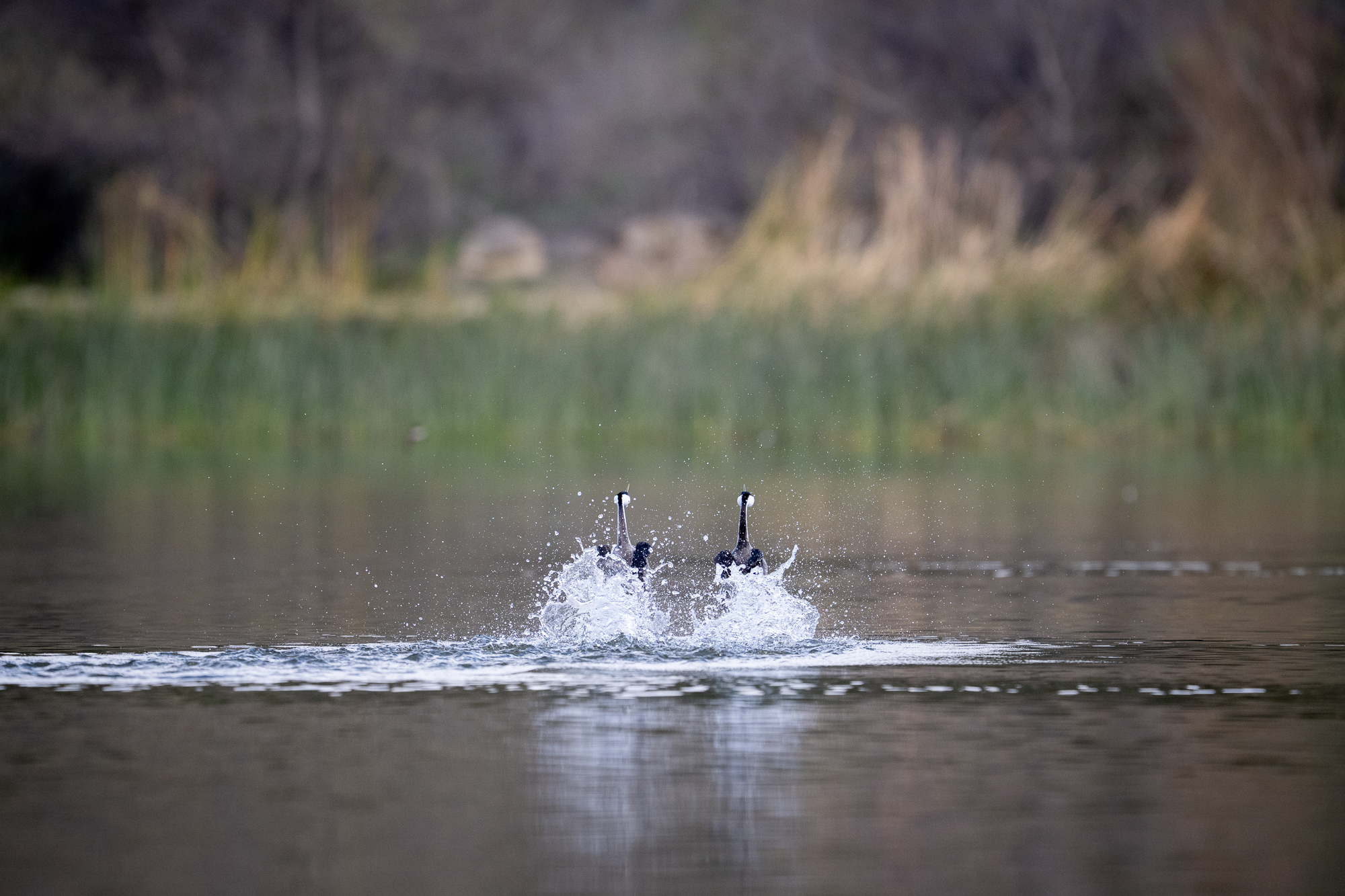
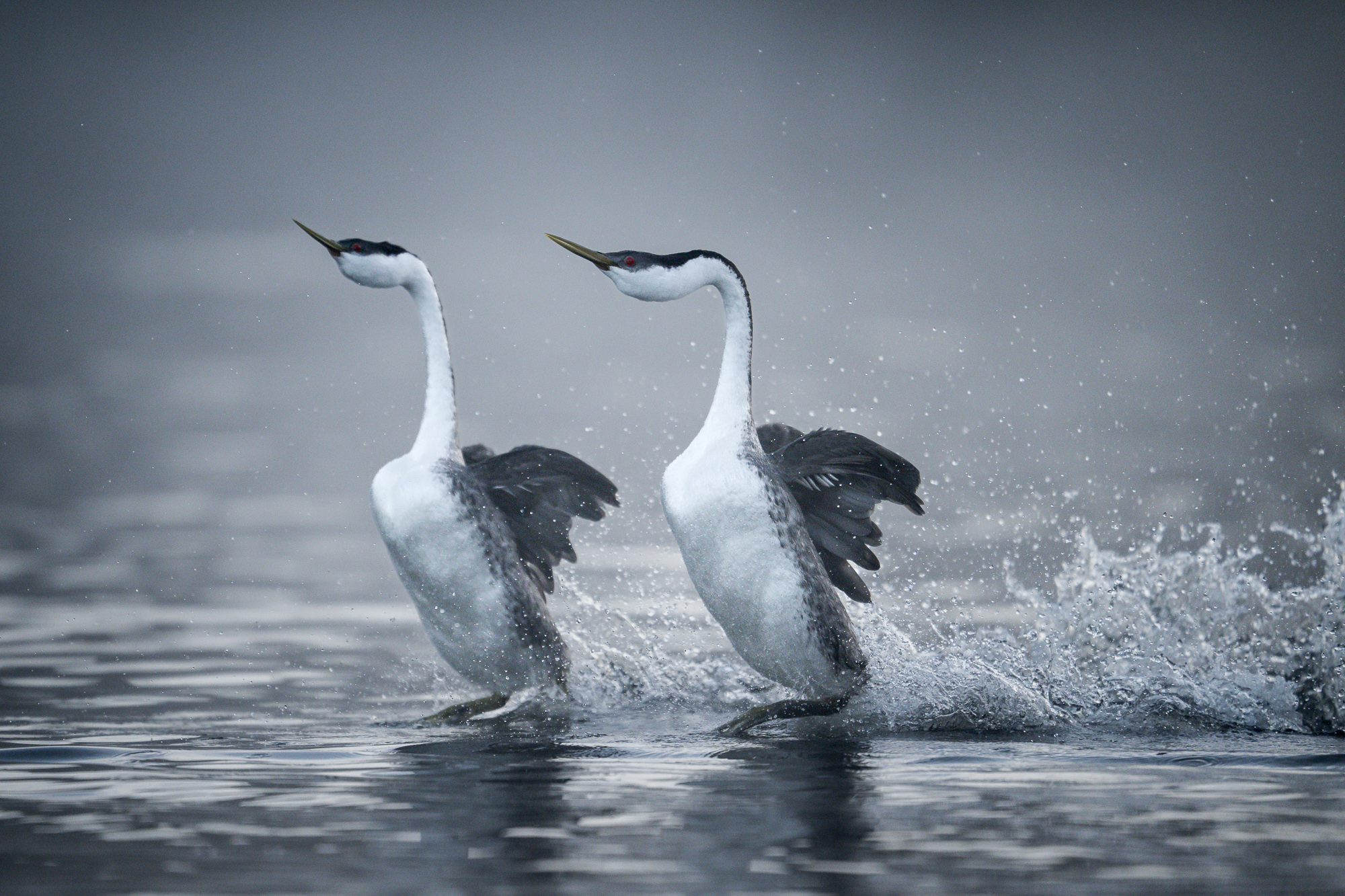
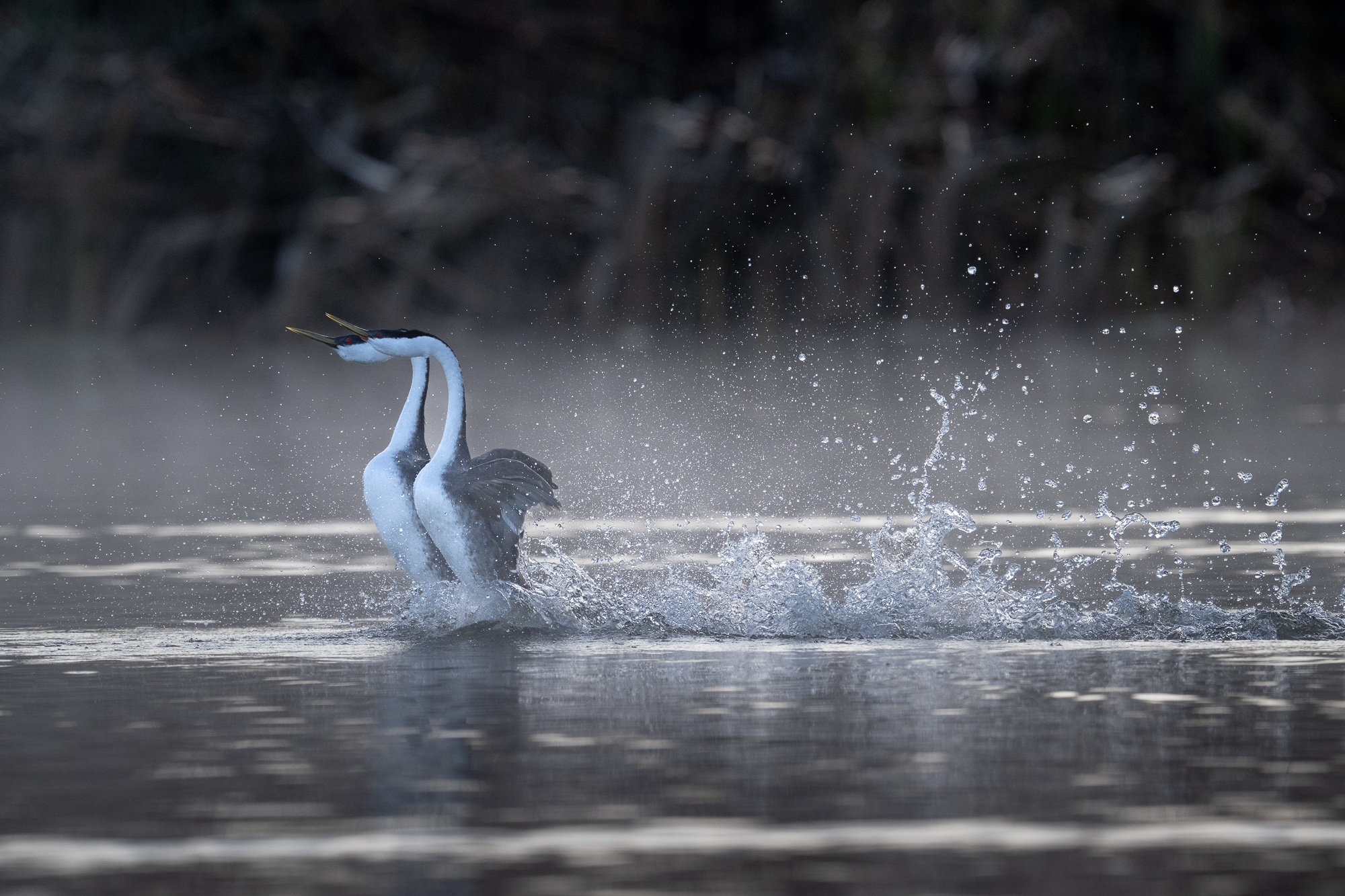
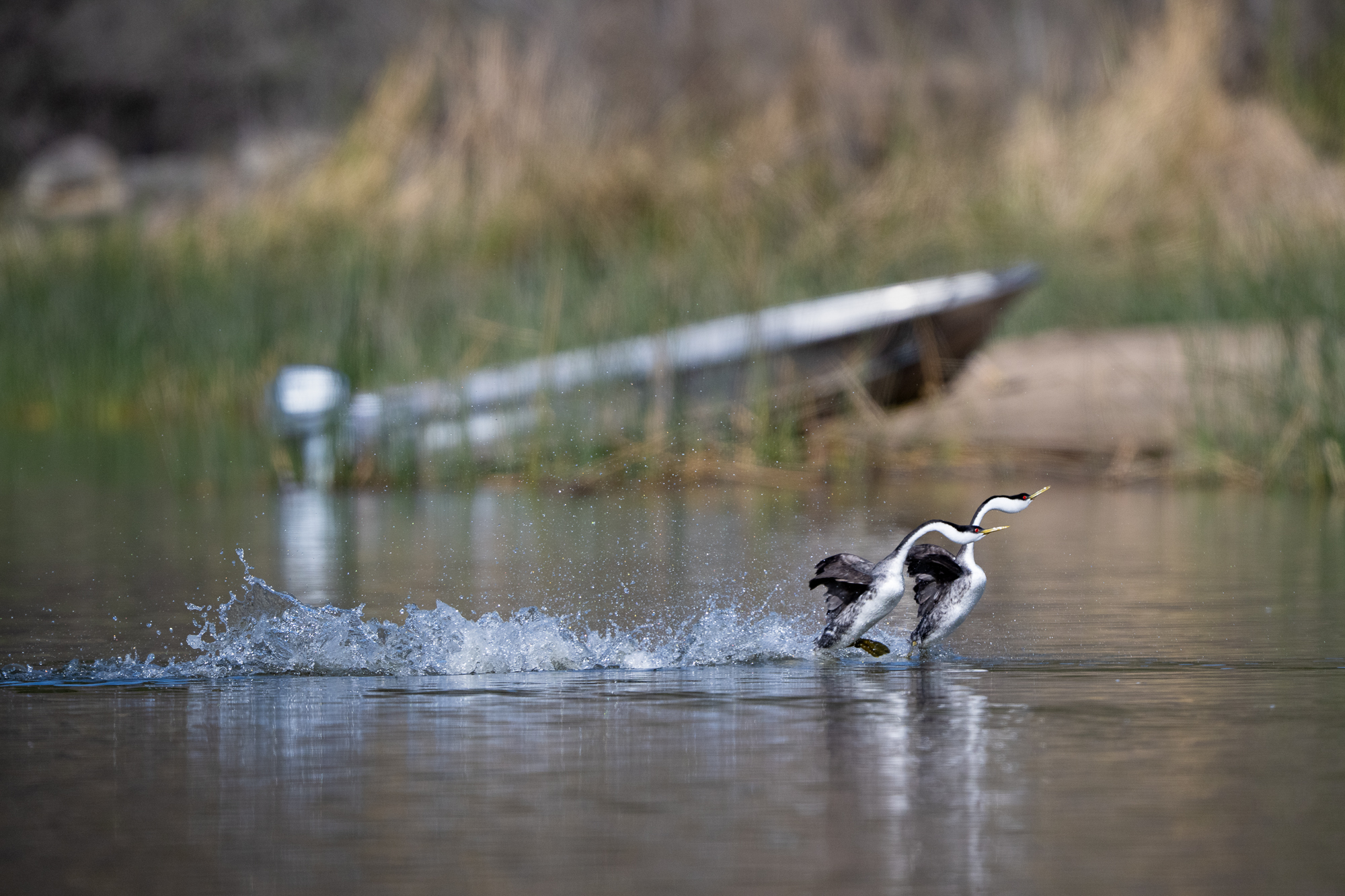
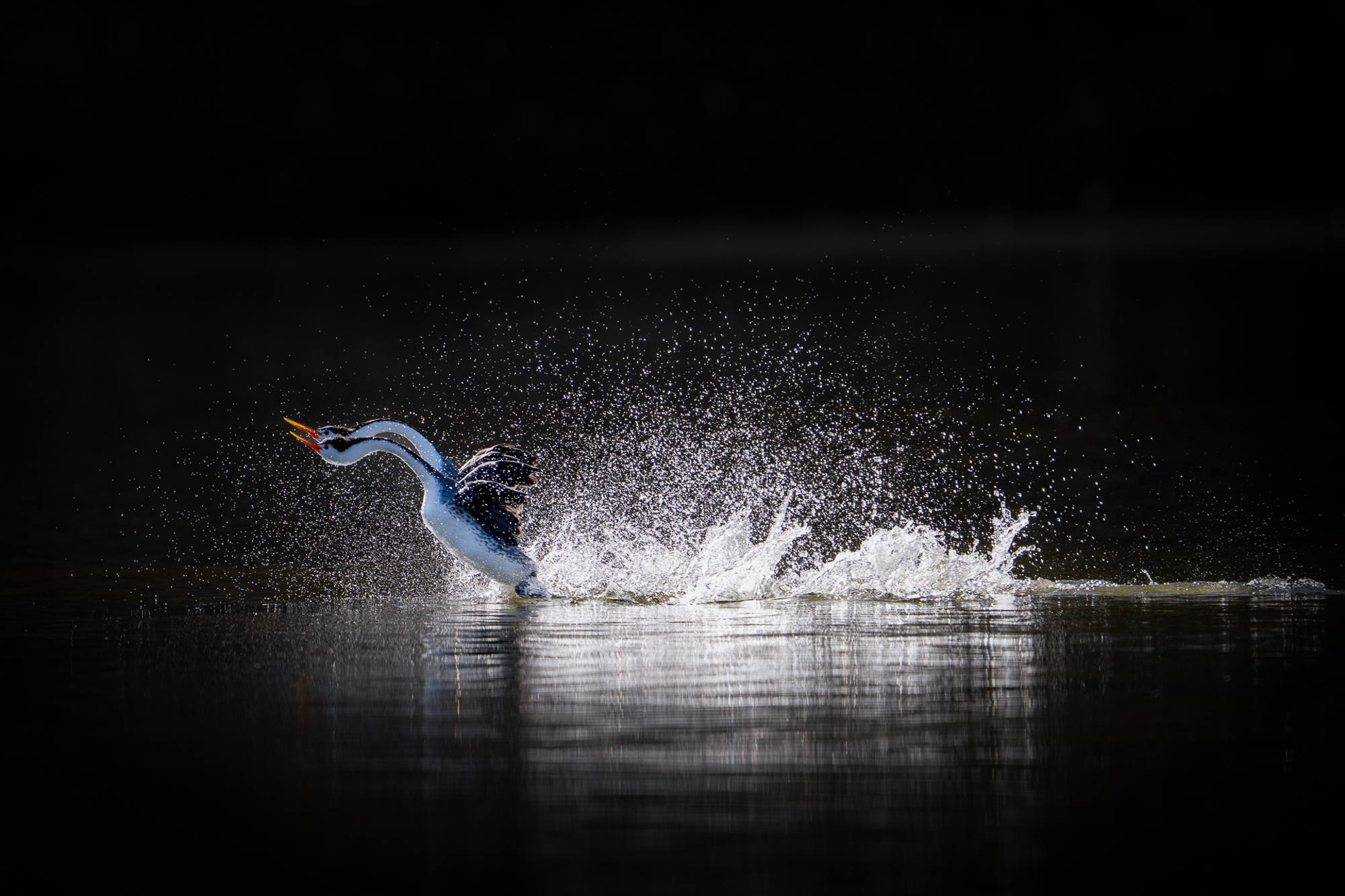
As the ceremony progresses, the grand show begins. Two or more birds rise up in the water onto their feet and scamper across the surface of the water together, running side by side. They stand straight up with their necks held high, their wings held back, and their feet churning the water like propellers. They rush for several seconds until the display concludes with a sudden dive. Rushing is not a race, but more like a synchronized dance.
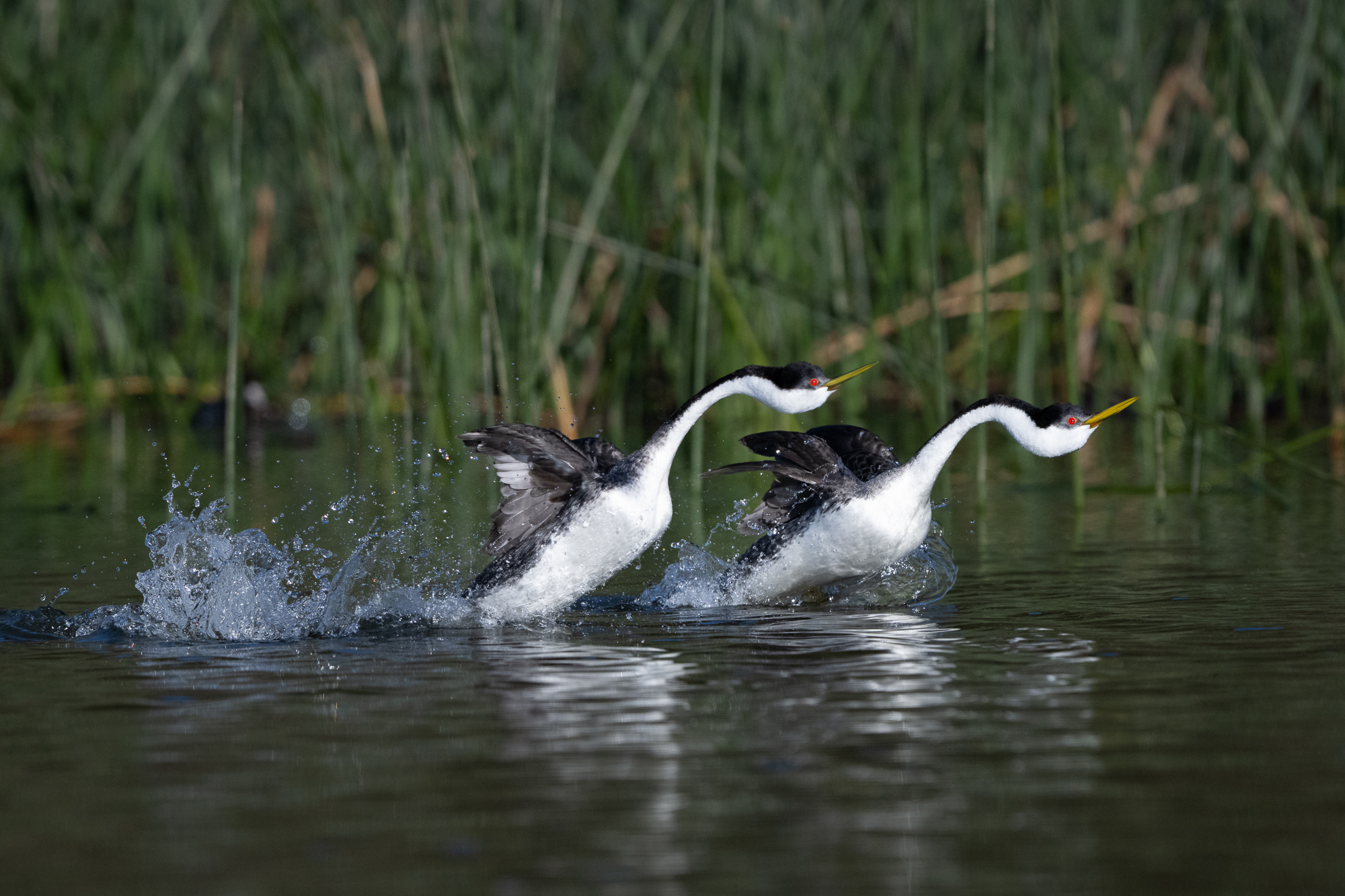
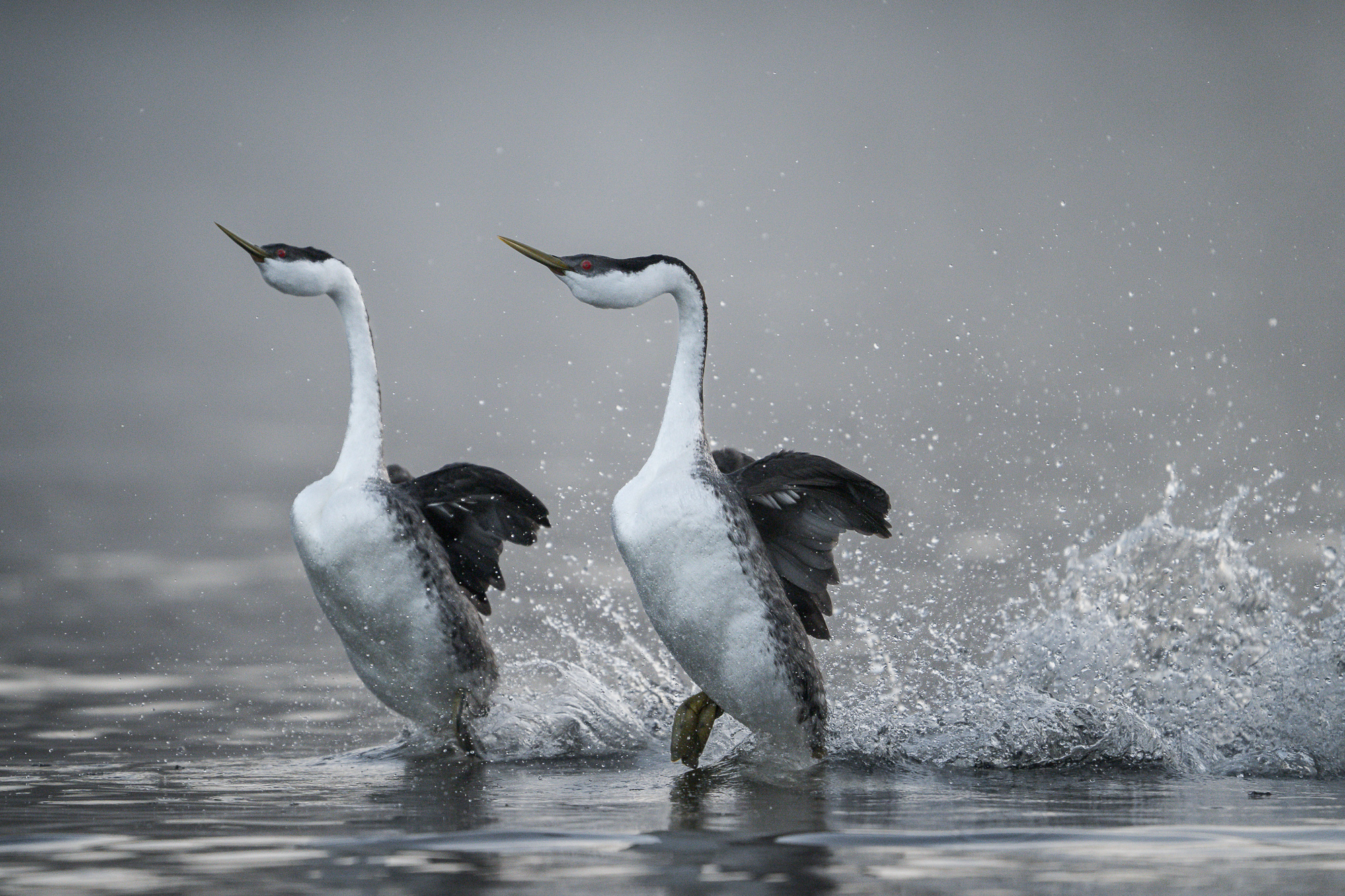
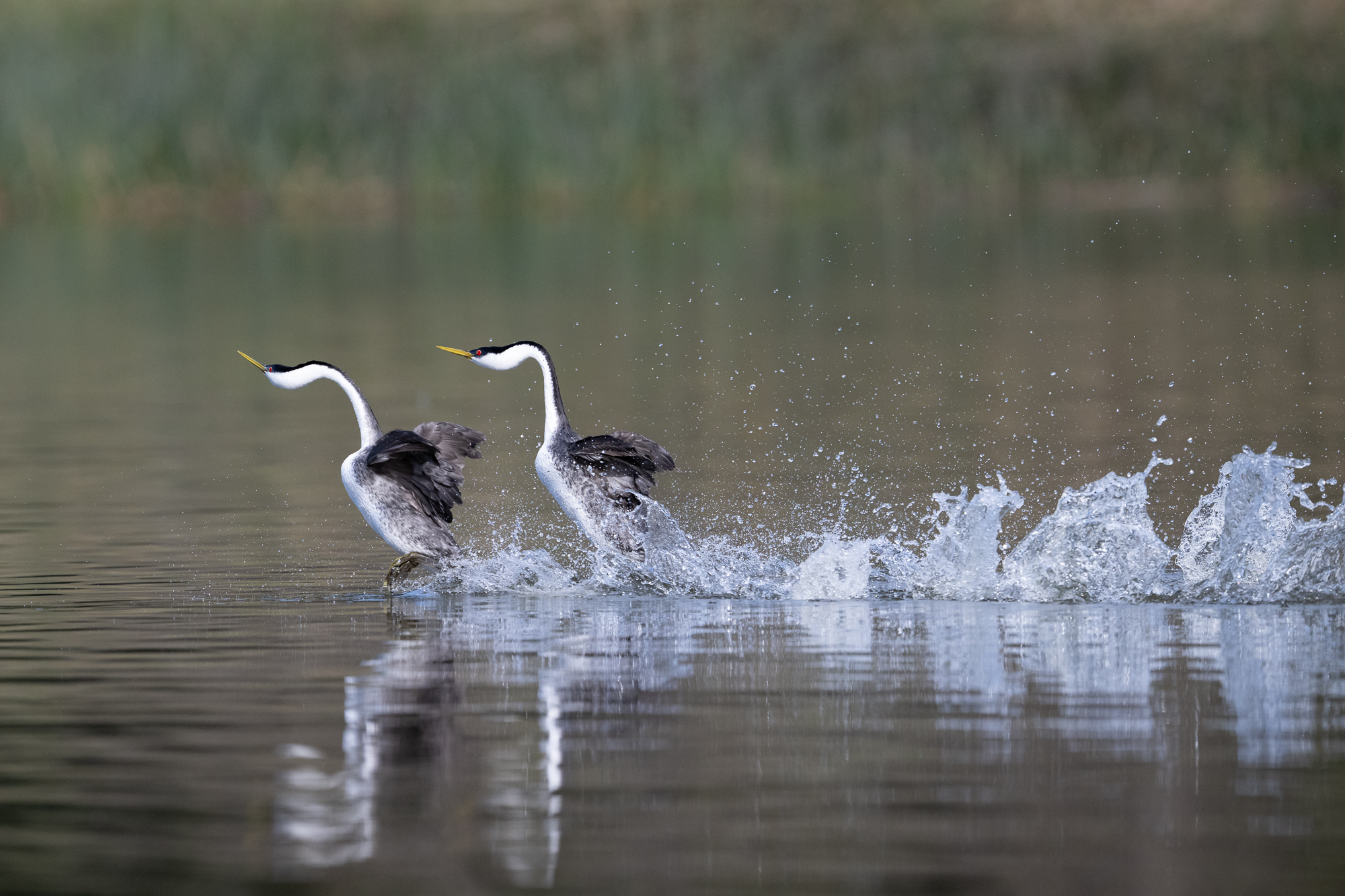
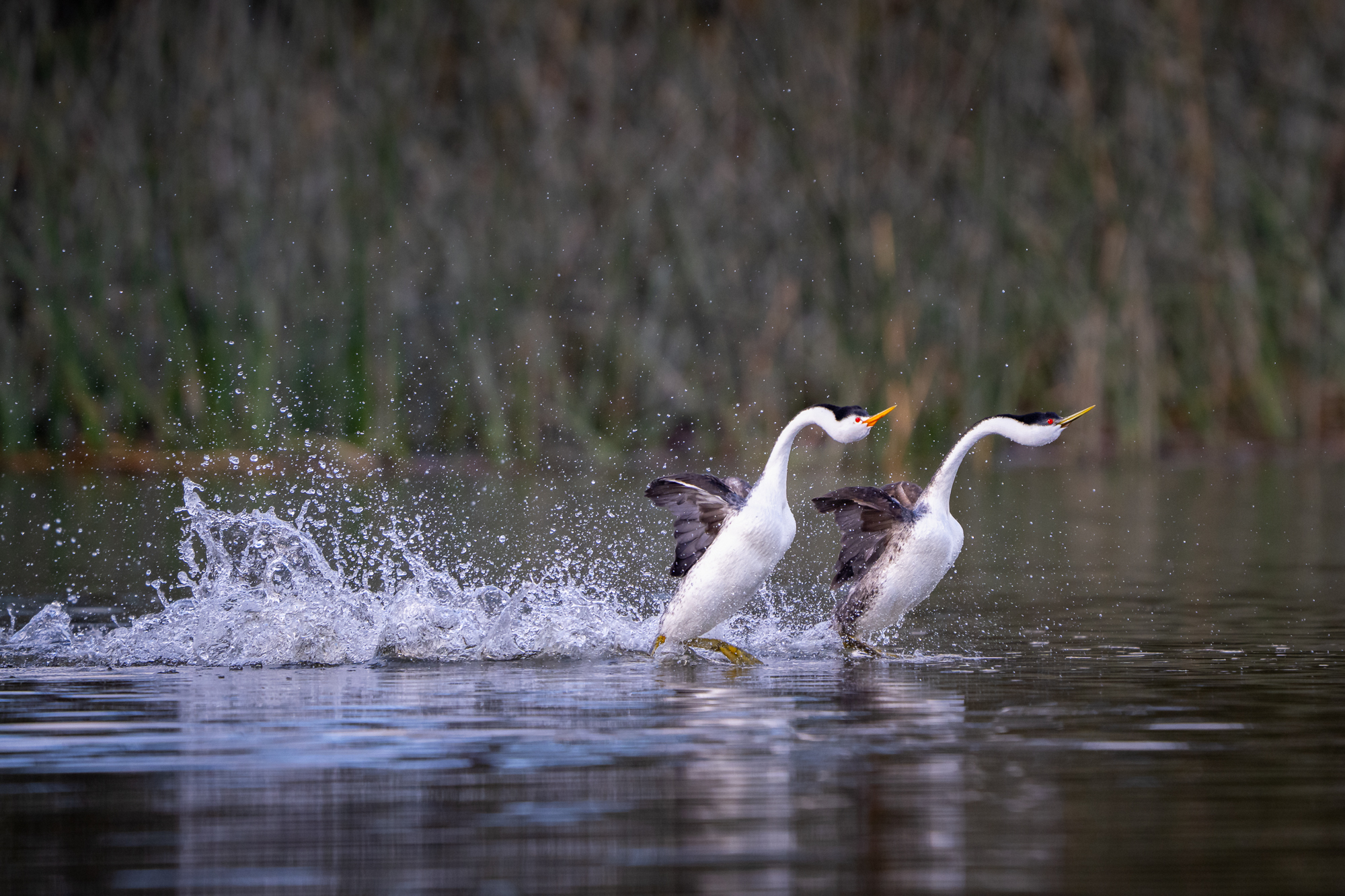

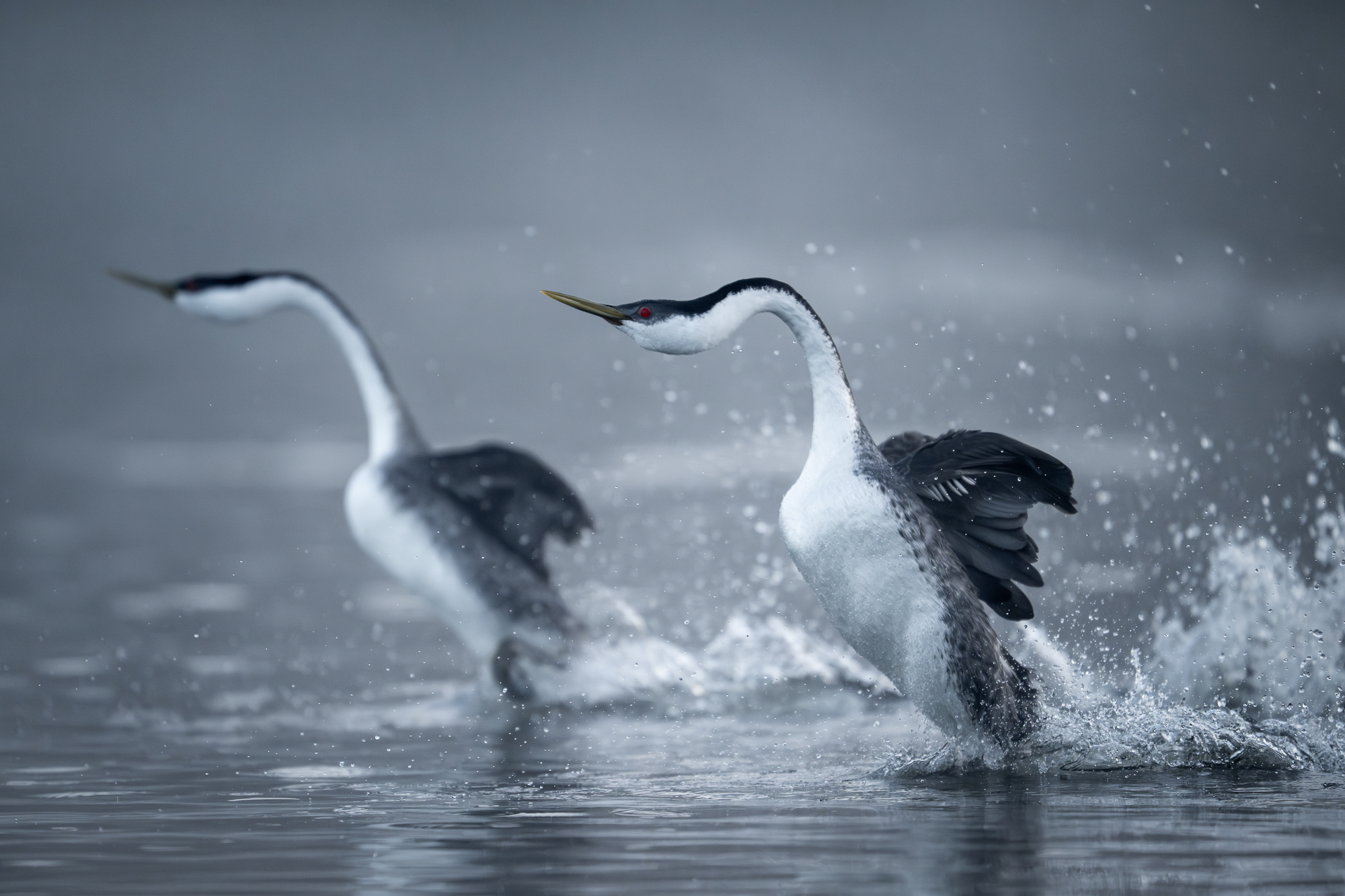
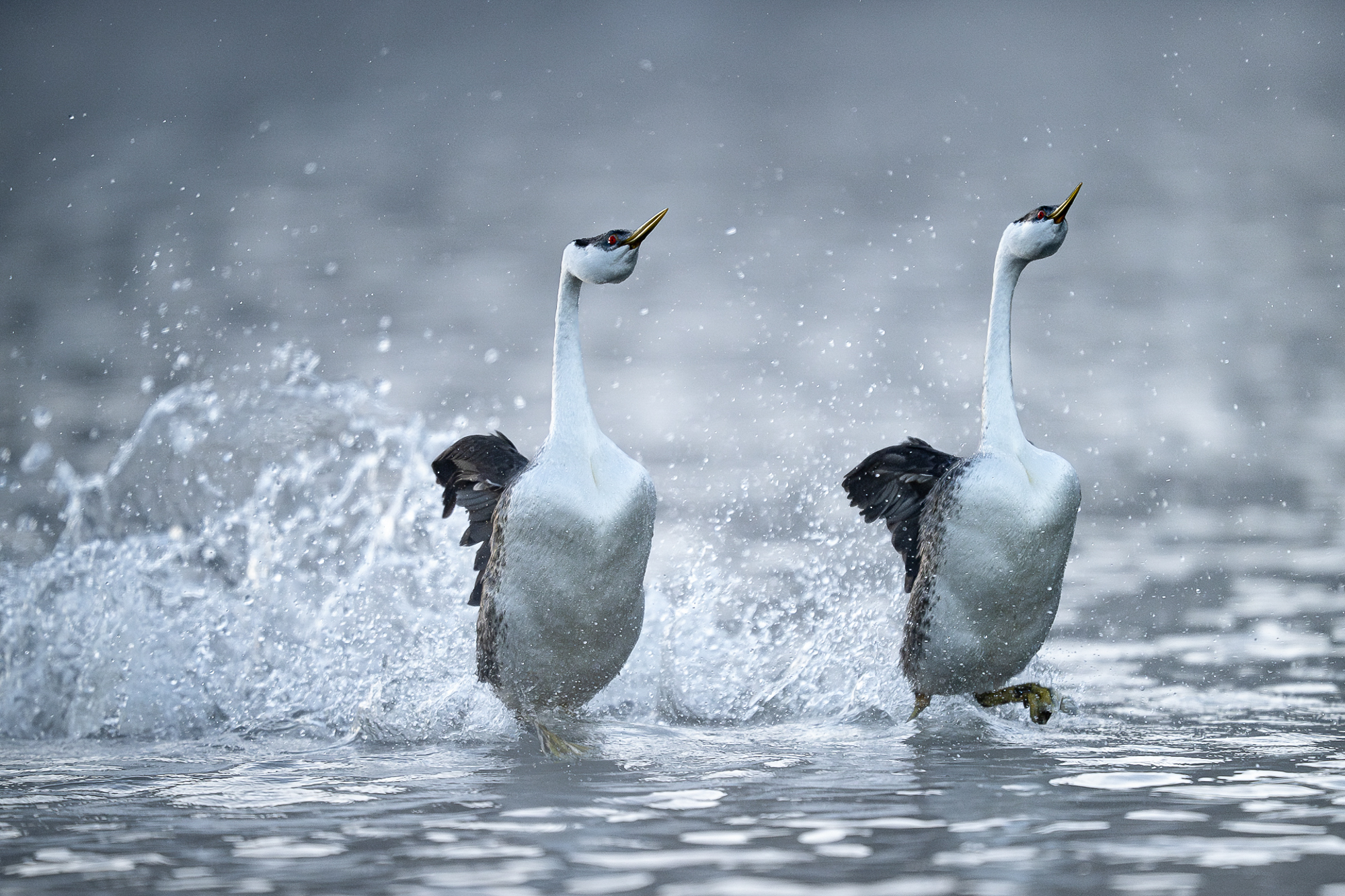
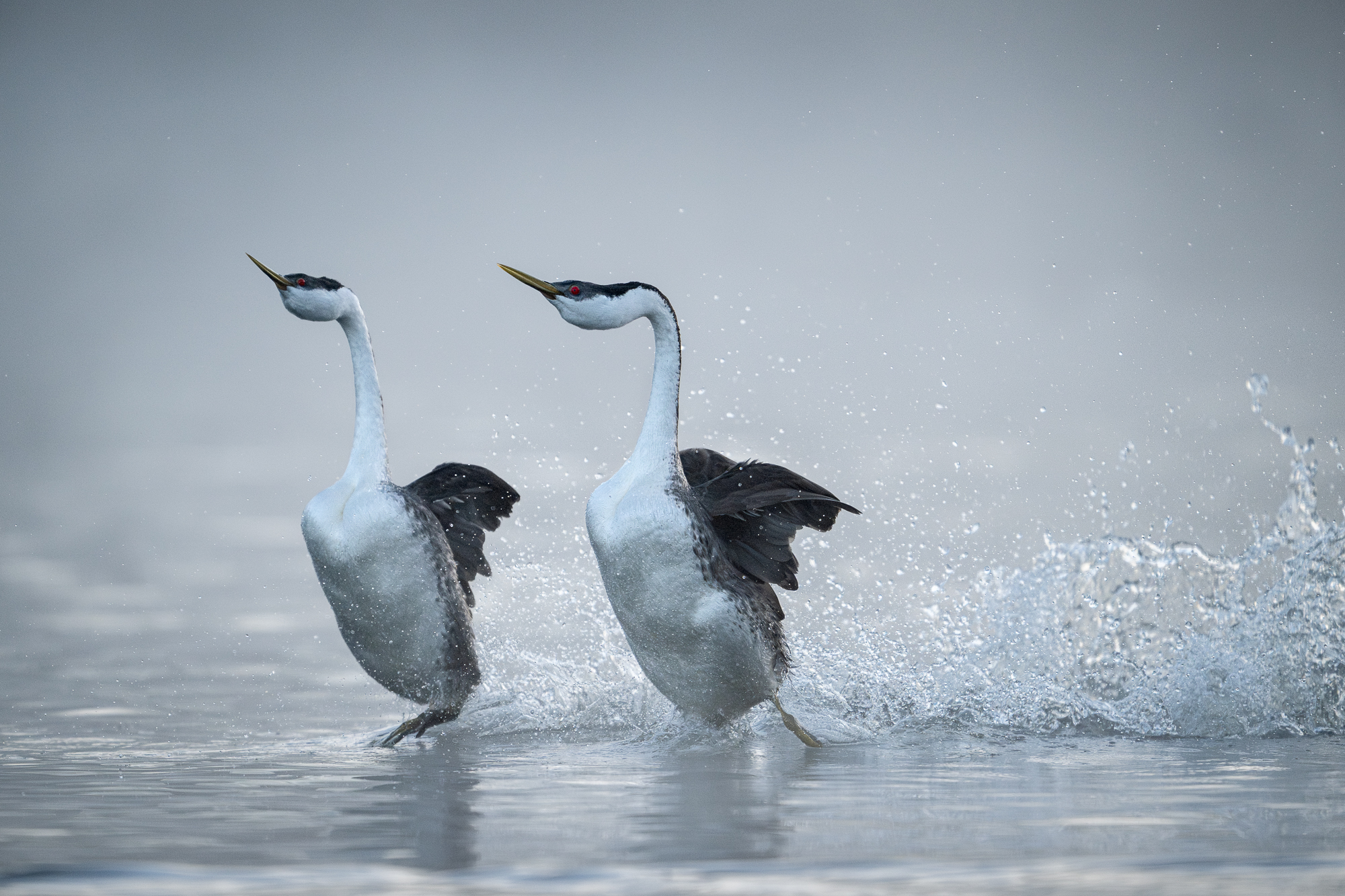


Opposite sex pairs perform this display together 55% of the time. Two or more males may also rush, presumably to attract females. In groups of three or more, there is usually one female and the rest are males. When one of two males attracts a female from his rushing behavior, a competition arises between males to court the female.

Countering Physics
The grebe is the largest animal with “water-walking” ability. As they rush, its wings are held behind and relatively compact, so they do not contribute significantly to lifting the bird. So how do they accomplish this feat? The answer lies in their feet. (Pun intended.)
The ability to walk on the water requires the grebe to rapidly push down on the water, resulting in the opposite reaction, the water pushing up on the grebe. Its feet are shaped like an oak leaf, with three-lobed digits. As they push down on the water the digits spread out to maximize surface area. When they pull their feet out again the foot is collapsed and turned sideways, to minimize drag through the water. Repeating this process 15-20 times per second allows them to generate the lift they need to walk on the water.
Barge Trilling (treading)
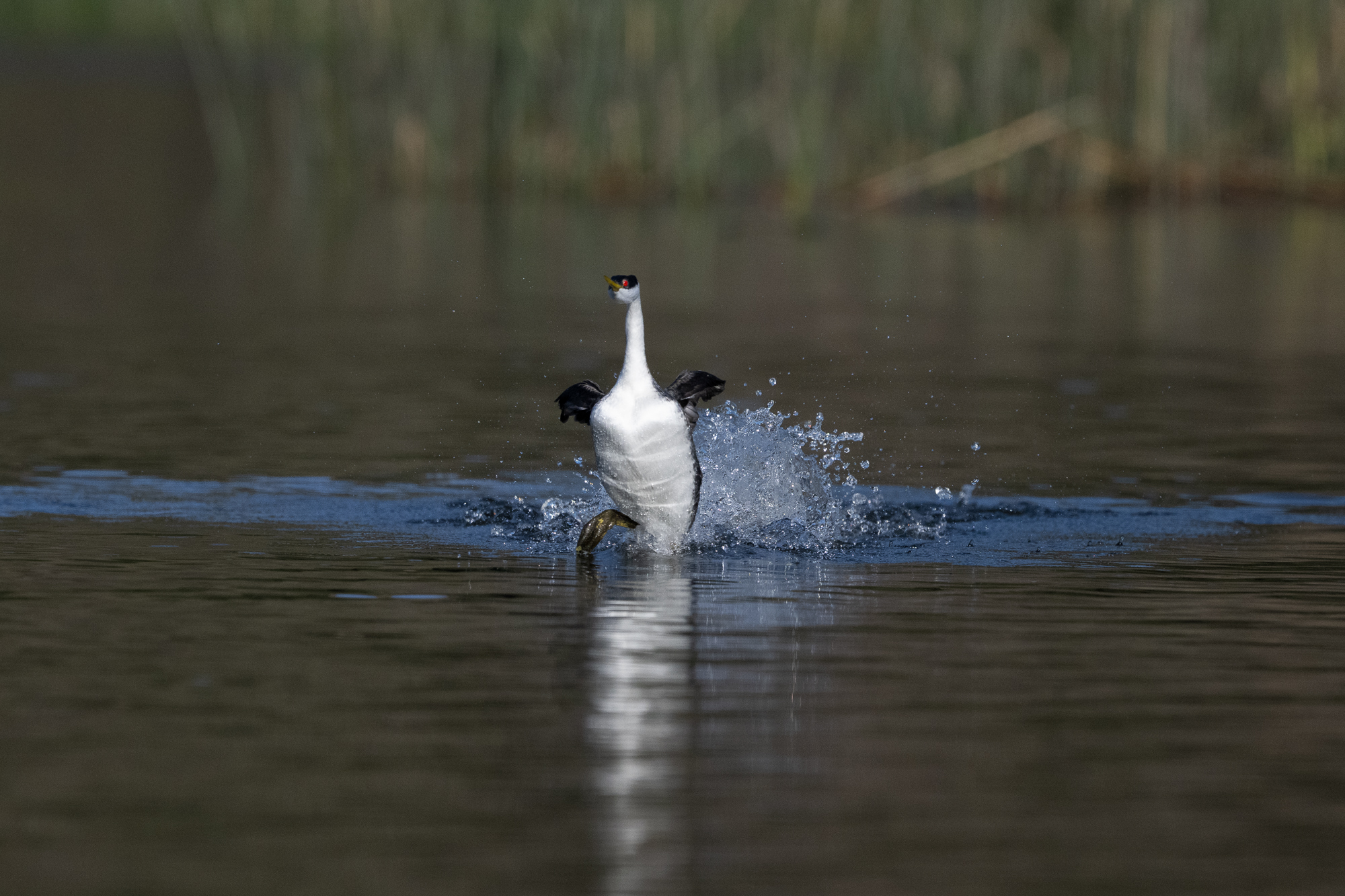
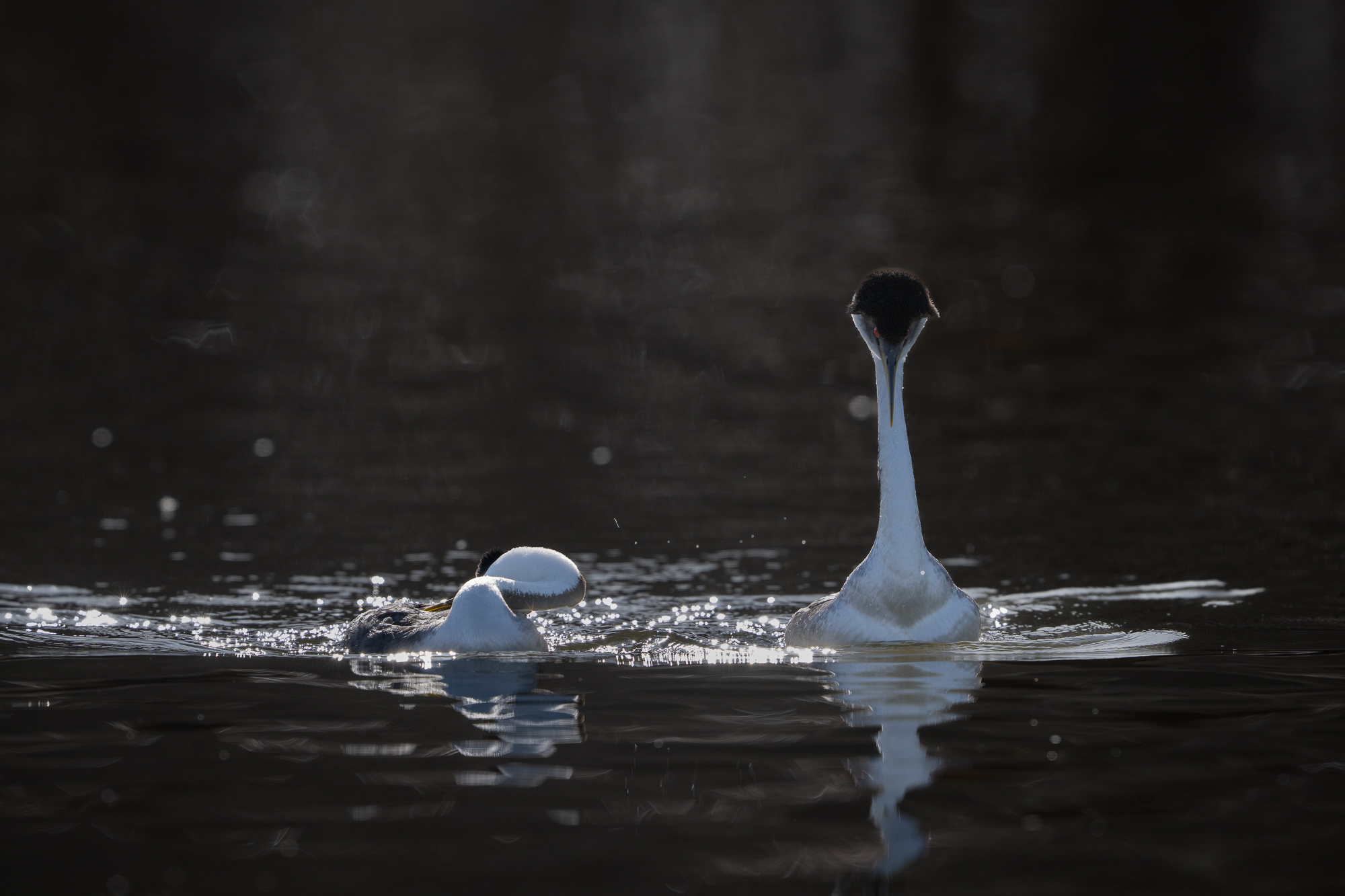
Another interesting behavior, usually performed by the male, is called barge trilling. With neck extended upward, crest raised, head horizontal, and wings folded, the bird vigorously paddles with its feet, causing the front half of its body to emerge vertically from the water. While paddling, the grebe emits a trilling sound, hence the name "barge trilling". This display is thought to be a way for males to show strength, attract potential mates and establish dominance.

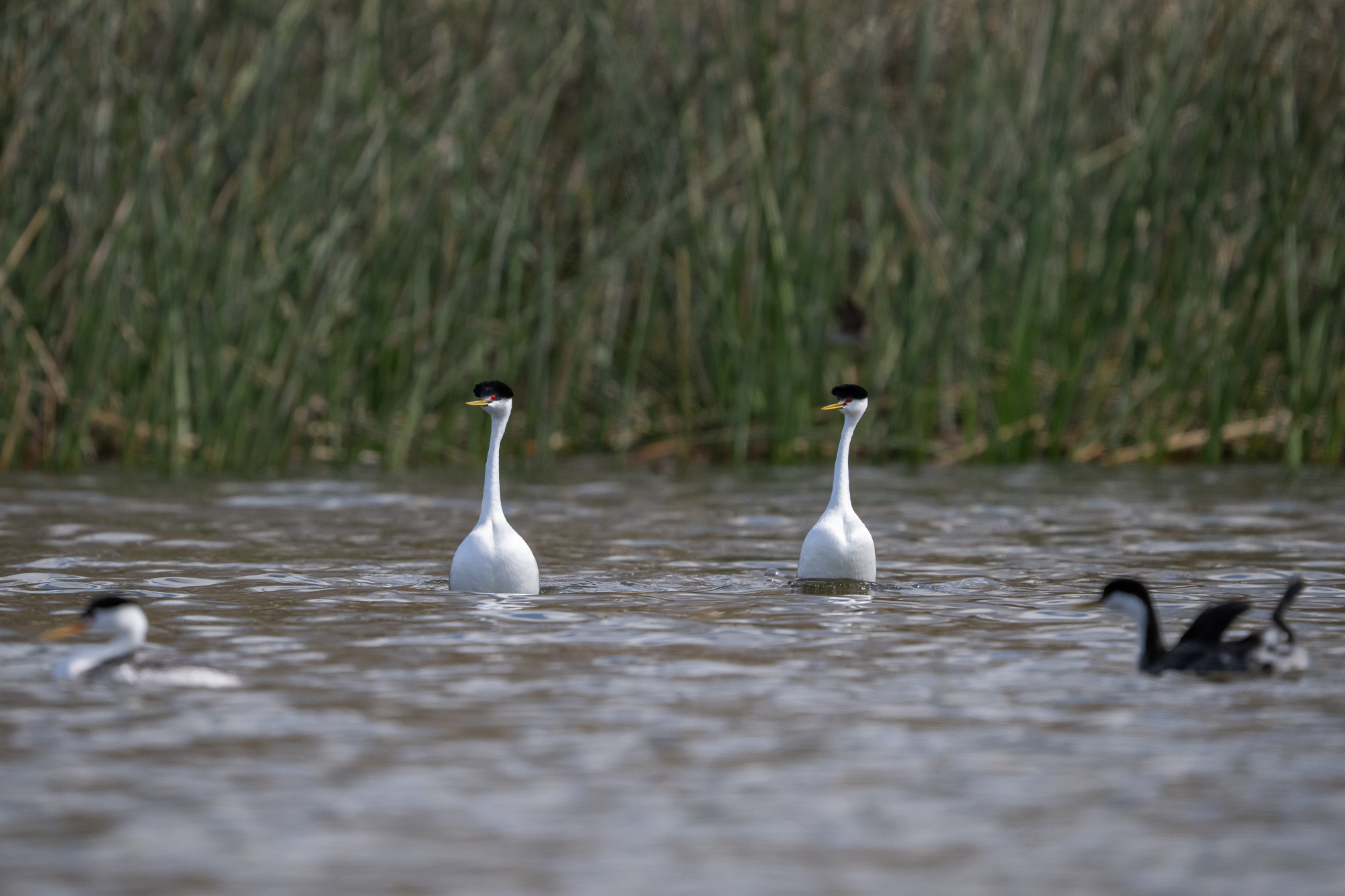
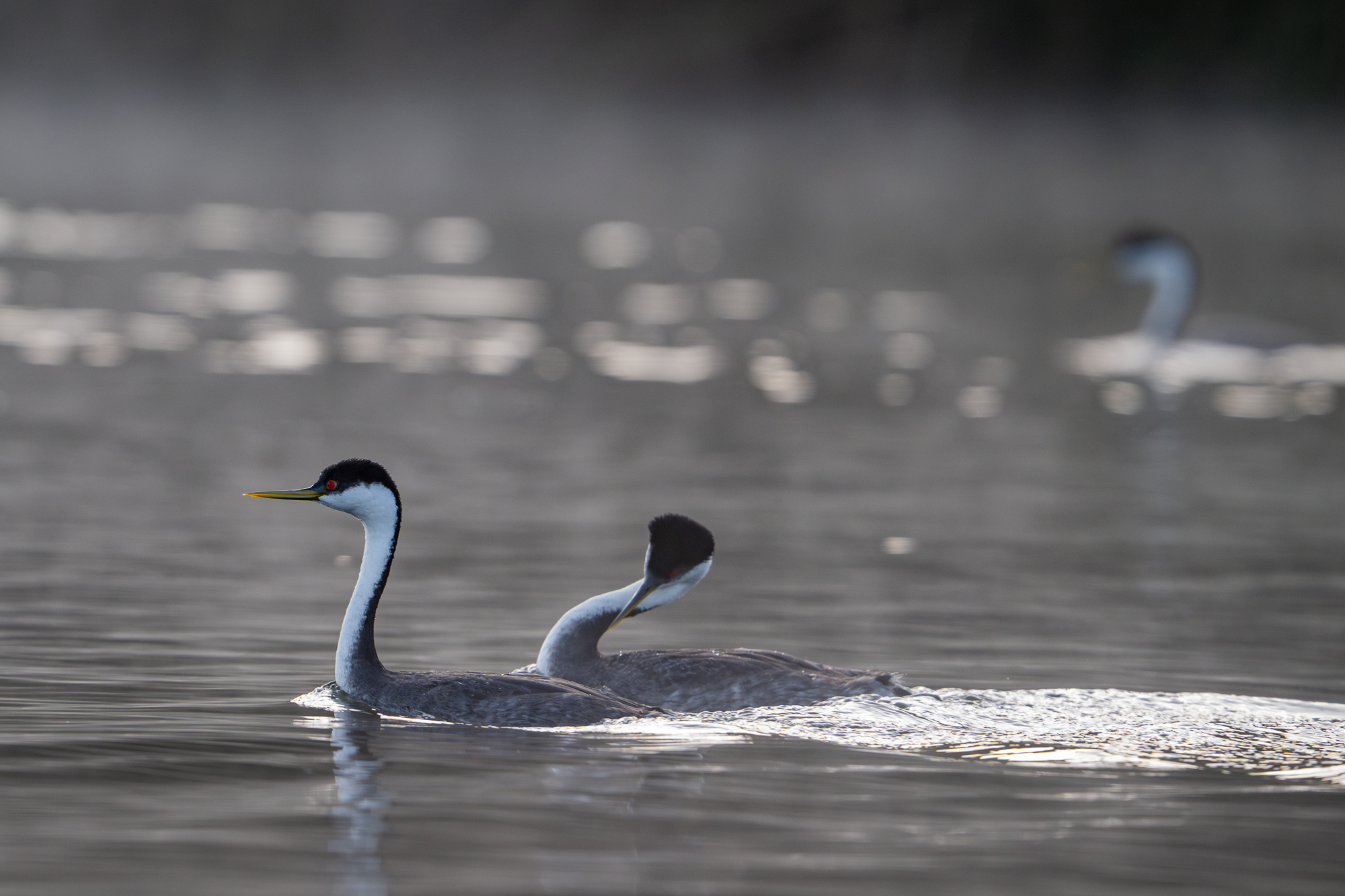
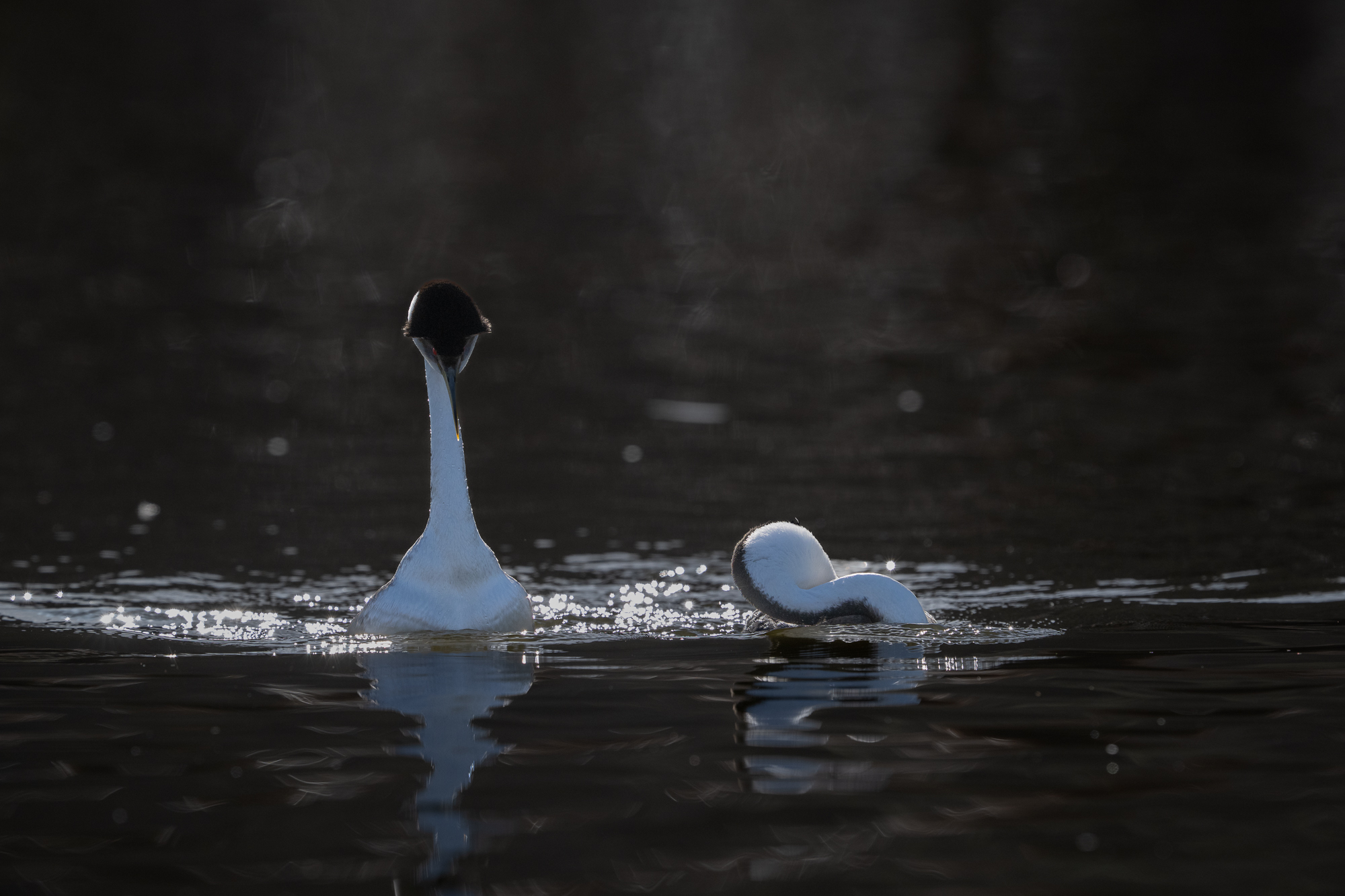
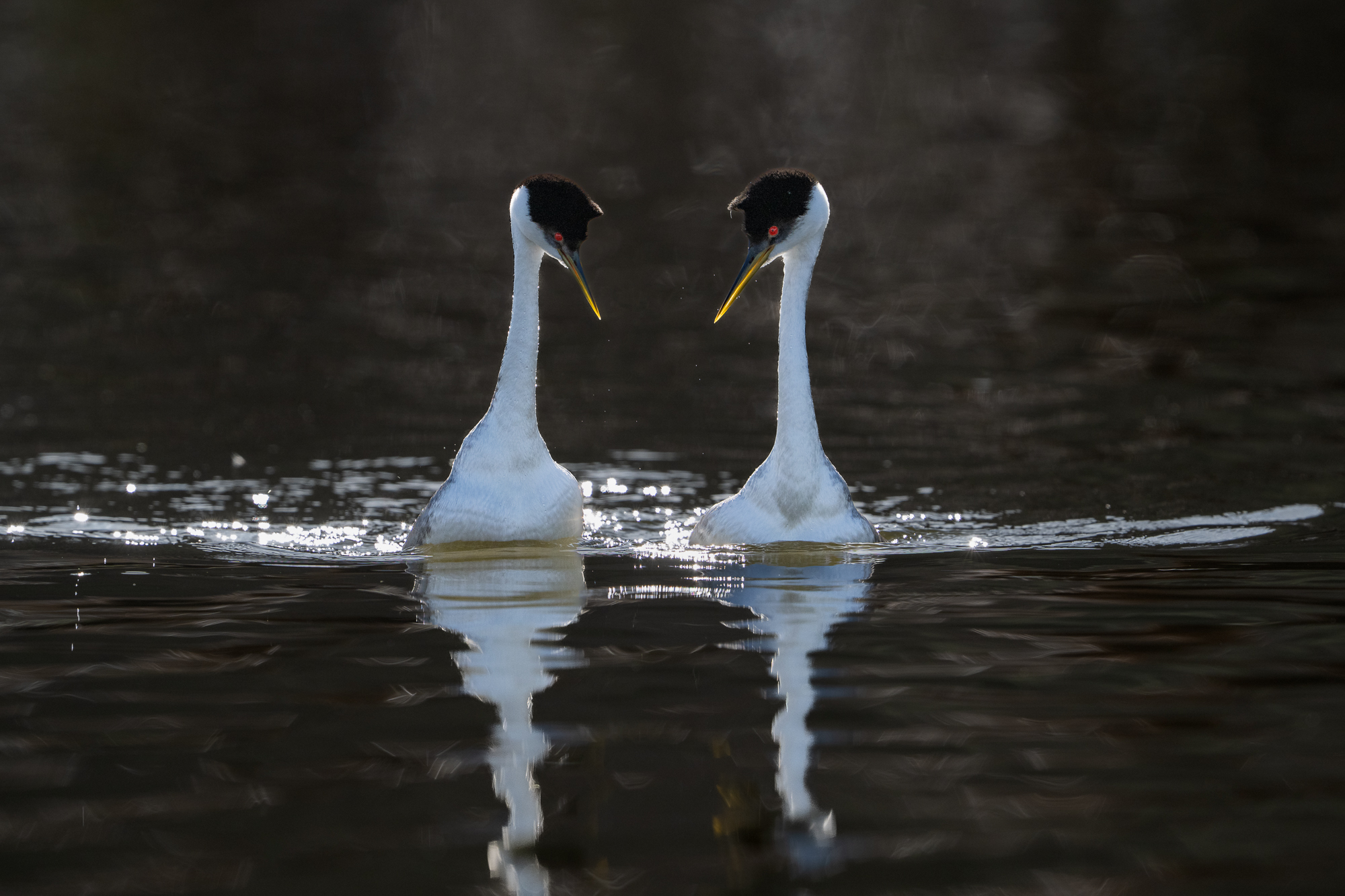
Bob-preening and mirroring are specific behaviors that occur between grebes that are already familiar, and have engaged in previous courtship activities. Bob-preening refers to a courtship display where the birds turn their heads to flick their back feathers with their bills. This will be mirrored by the other in the pair. These are signs of pair-bonding.

Weed Diving
Later in the courtship comes the “weed diving”, which is part of the “weed ceremony". Each bird dives to pick up vegetation and surfaces with weeds in their beaks. Both then stand up in the water, facing each other, and approach closely. They then drop the plants and preen. This is a prelude to mating and nest building.

Weed Dancing
With weeds in its bill, each bird rises to a nearly vertical position and turns vigorously with its feet, so that two-thirds of its body remains out of the water. The two birds will come together and touch, continuing the slow turns, gracefully pivoting around each other.
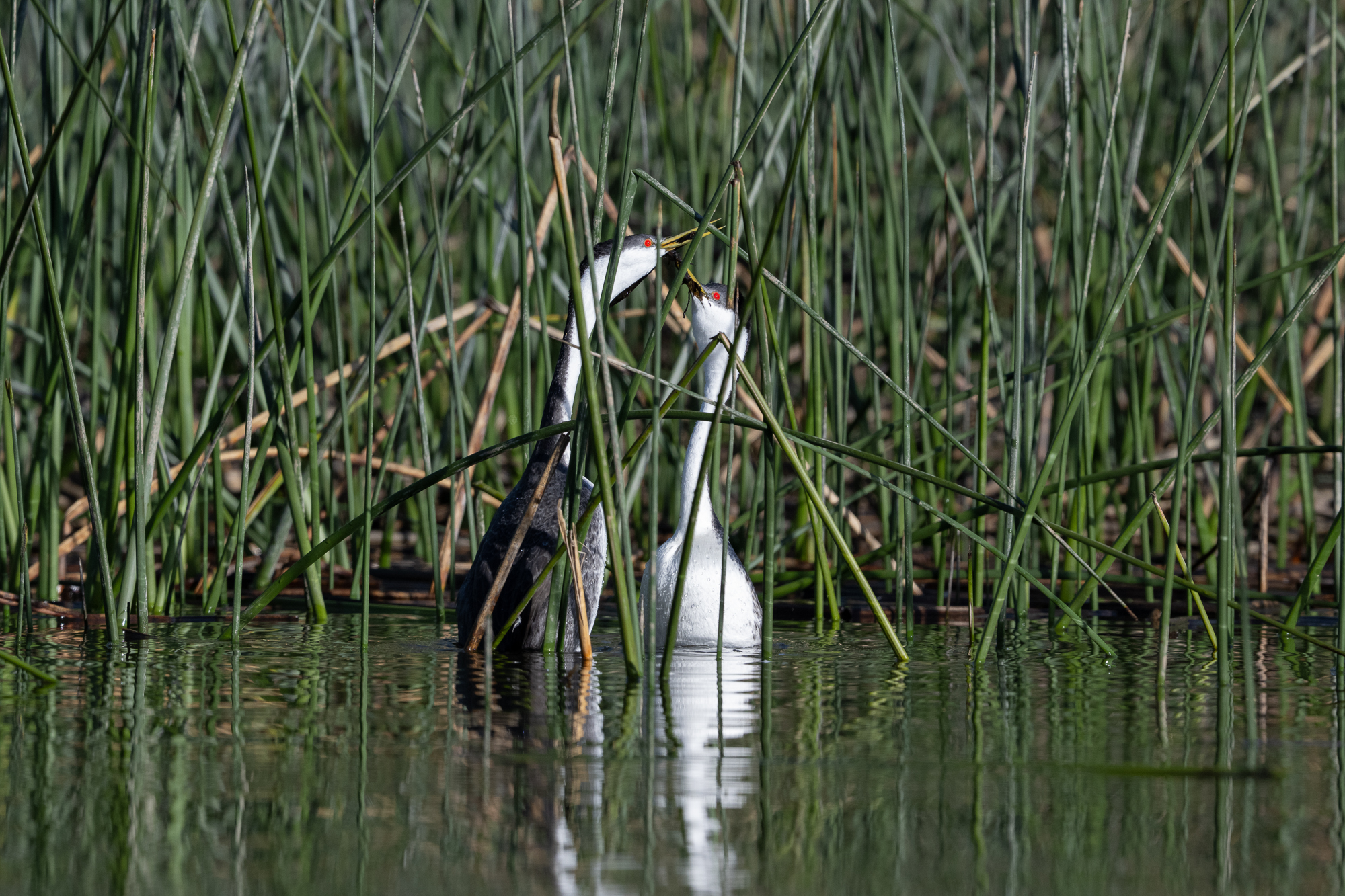
Later in the season comes… (A blog post for another day!)
Mate Feeding
“Mate-feeding” is another behavior that occurs in the later stages of pair formation, usually one to three weeks prior to building a nest platform. The female grebe will begin to demand food by repeatedly giving loud begging calls between the dives of the male grebe. He will feed her as long as she begs for food.
Nesting
Males select the nest site and feed females during the early part of the nesting season; both are territorial at the nest. Western grebes nest in colonies on lakes and build floating nests from plant debris and sodden materials. Nests are designed to move up and down as the water levels fluctuate. Water depth below the nest is usually less than a foot, and most nest sites are sheltered from wave action. They can be 2-3 feet across. Mating occurs on the nest. Clutch size is usually 2-3 eggs that incubate for 24 days.
Hatching
Hatchlings are covered in a silvery down and famously ride on their parents’ backs.
Hybridization
As mentioned above, Western and Clark’s Grebes were considered the same species until 1985 and the two species rarely interbreed. But late-courting Western Grebe males may produce hybrid offspring with Clark's Grebes, as conspecific mating opportunities decrease.
Declining
Populations of Western Grebe were stable or declining from 1968 to 2015, according to the North American Breeding Bird Survey. Partners in Flight estimates a global breeding population of 87,000 individuals, and places them on the Yellow Watch List for species with declining populations. Although the species has benefited from the creation of reservoirs and other wetlands, loss of natural wetlands and extensive hunting certainly led to historical declines in their populations.
Due to the particular placement of the Western Grebes’ nests, this species is particularly sensitive to fluctuating water levels. Also, like many waterbirds, the Western Grebe is also sensitive to pesticides, habitat degradation, oil spills, and gill nets.
During the rushing ceremony, these birds may be reasonably tolerant of humans. But when nesting they are especially sensitive to disturbance by humans. In readily accessible nesting areas, no-go zones are well demarcated and cordoned-off. These boundaries should be respected.