
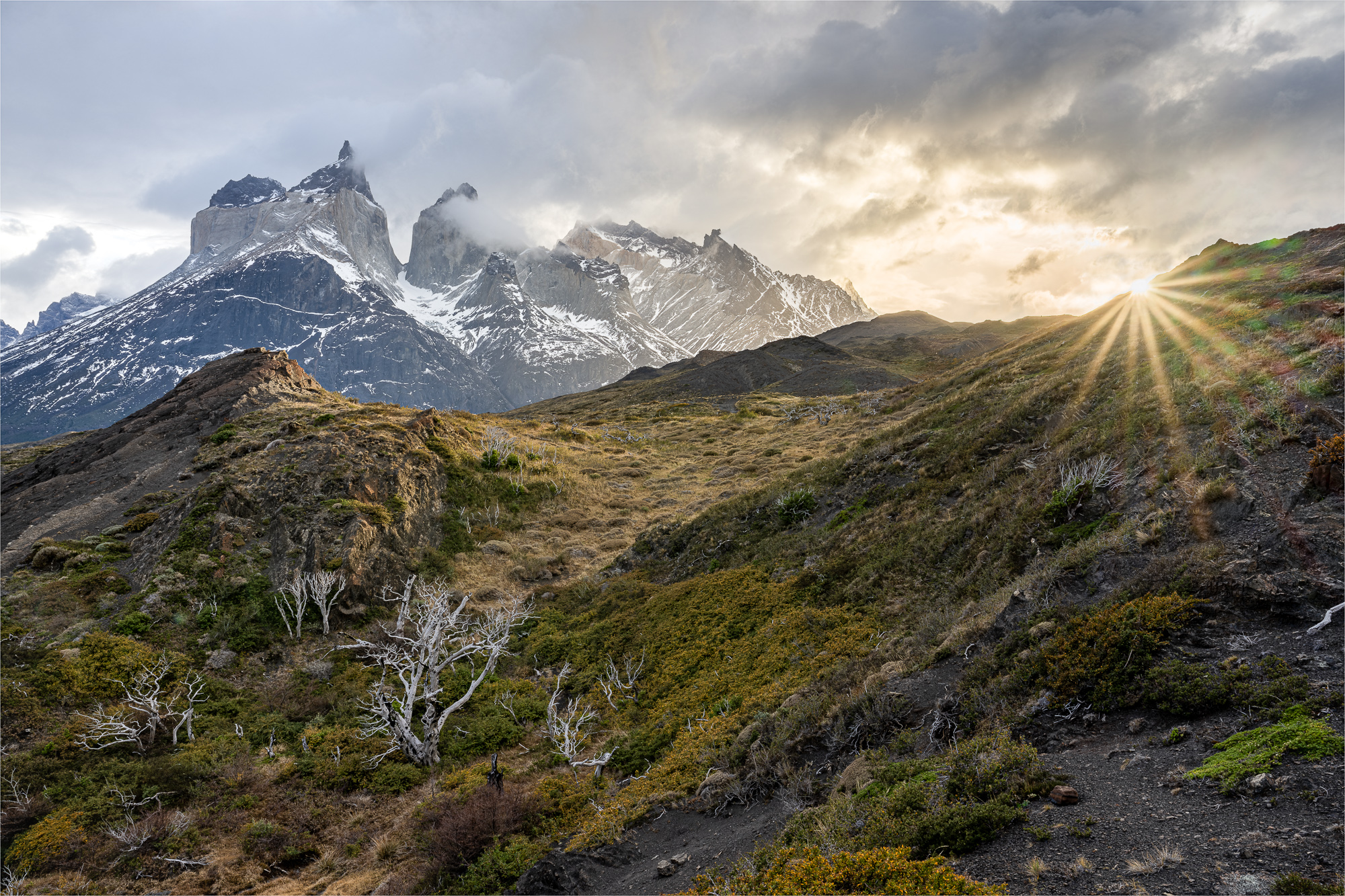
Recovery
Chile, South America
Granite mountains, peaks and spires are dispersed throughout the undulating terrain of Chile’s Torres del Paine National Park. The Sine qua nons are the famous Cuernos del Paine, with their towering peaks and distinct shapes. Throughout the park the terrain is diverse and harkens for exploration. There are natural wonders around just about every corner.
This section of the park was relatively recently devastated by wildfires, which have plagued Torres del Paine several times. They struck hard in 1985, 2005 and 2011-12, usually as a result of human error in a region known for its high winds.
But nature is resilient, and if left to itself will recover. Distinct phases of its recovery can be identified. Fire leaves behind nutrient-rich ash. The surviving underground roots and seeds quickly sprout with fast-growing weeds and grasses covering the soil quickly. This so-called Immediate Stabilization goes on for 1-2 years. Pioneer Takeover then occurs over 2–10 years, wherein hardy plants and shrubs move in. These pioneers alter the environment by adding organic matter to the soil and create shade, allowing slower-growing plants and small trees to take root in the later Intermediate Growth phase. Over the next 10-50 years, animal life slowly returns as food and shelter options increase. The Climax Community is a mature ecosystem. In Patagonia, this means the return of dense native forests, which require decades of shade and rich soil to mature.
Photo © copyright by Dr. Edward Mikol.
Photo Prints
Metal Prints
Canvas Prints
Acrylic Prints