
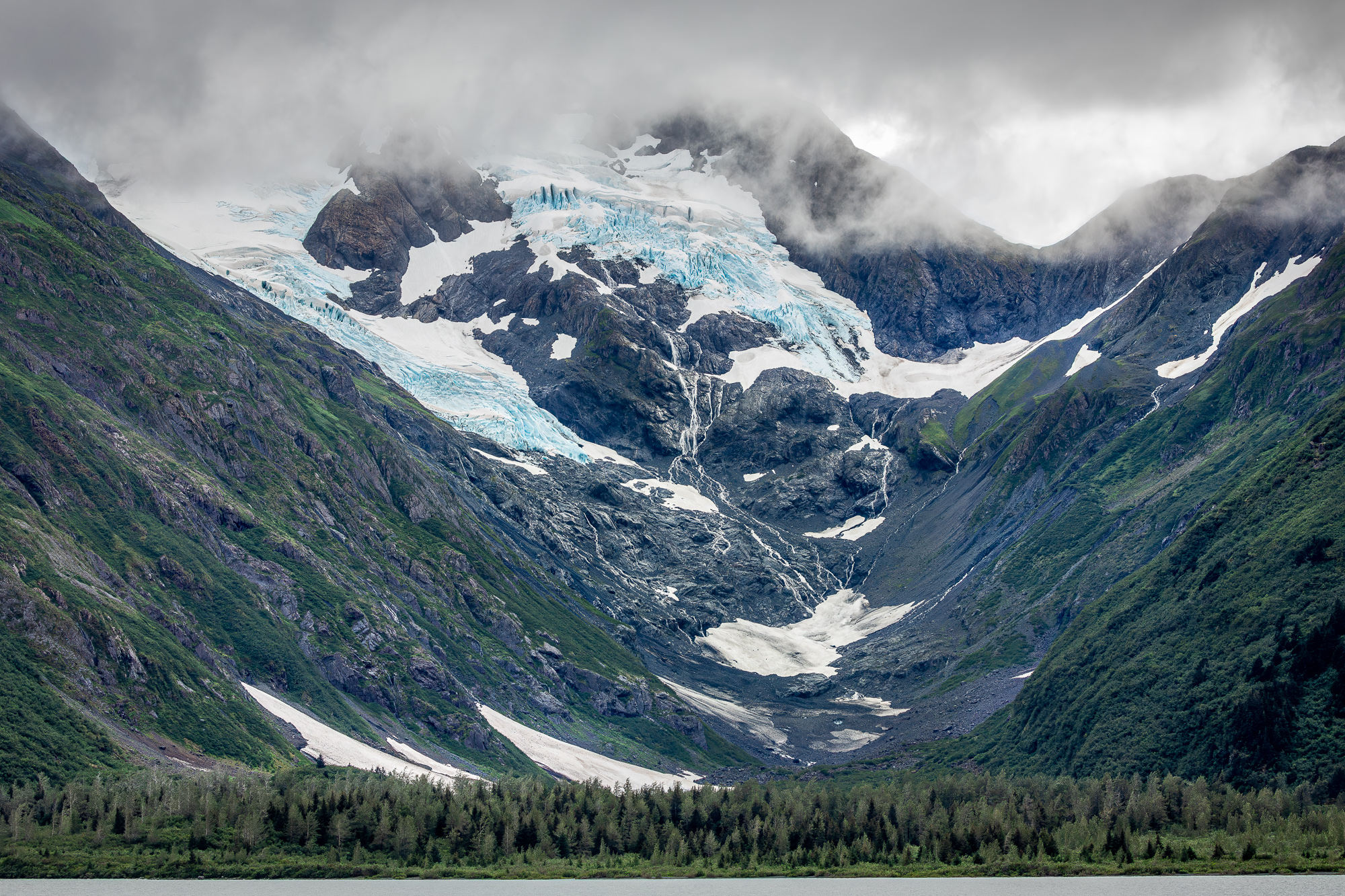
Receding Glacier
Alaska, USA
A glacier is a persistent body of dense ice that is constantly moving downhill under its own weight. A glacier forms where the accumulation of snow exceeds its dissipation over many years. In temperate glaciers, snow repeatedly freezes and thaws, changing it into granular ice called névé. Under the pressure of the layers of ice and snow above it, this granular snow fuses into denser firn. Over a period of years, layers of firn undergo further compaction and become glacial ice, which has a distinctive blue tint because it absorbs a portion of the red spectrum of light.
Glaciers move downhill by the force of gravity and the internal deformation of ice that occurs due to pressure. As it moves, it abrades rock and debris creating landforms such as cirques, moraines, or fjords. When a glacier's size shrinks below a critical point, its flow stops and it becomes stationary. If the snow up at the top is not replenished, the glacier recedes. Meltwater within and beneath the glacier ice leaves stratified alluvial deposits, that sometimes end in lakes, rivers, or the sea.
Photo © copyright by Dr. Edward Mikol.
Photo Prints
Metal Prints
Canvas Prints
Acrylic Prints