

Hangin' Around
Costa Rica
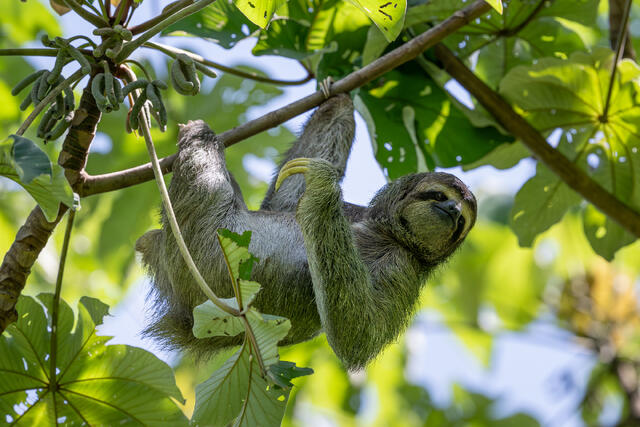
The three-toed sloth is the only member of the genus Bradypus, which means slow-footed. There are five species of three-toed sloths, with only the Brown-throated Sloth (Bradypus Variegatus) found in Costa Rica. They are famously slow-moving, traveling at an average speed of 0.15 mph, and spend up to 20 hours a day sleeping to conserve energy.Sloths are arboreal, with a body adapted to hanging by their limbs.
Sloths live high up in the canopy, their large, curved claws and muscles specifically adapted for strength and stamina. Interestingly, the muscles that sloths use to produce a pulling motion are much stronger than those that produce a pushing motion. So they can easily grip and hang from trees, but they struggle to support their body weight when walking on all four limbs. Sloths are agile swimmers.
Sloths have the slowest digestion system of any mammal. The leaves, fruits, and sap of various trees make up the bulk of a sloth’s diet. It takes about a month for a single leaf to pass through its four-chambered stomach and digestive tract. Sloths get most of their fluids from the leaves that they eat, but they have been observed drinking from rivers. They descend once a week to defecate on the forest floor to make room for more food.
Their long, coarse fur often appears greenish due to algae growing on it. Since the sloth’s fur is so good at absorbing and retaining water, the green algae receive protection and sustenance. In exchange, sloths will consume the algae growing on their fur, providing them with additional carbohydrates and lipids. Their greenish color also provides the sloths an effective camouflage.
Photo © copyright by Dr. Edward Mikol.
Photo Prints
Metal Prints
Canvas Prints
Acrylic Prints