

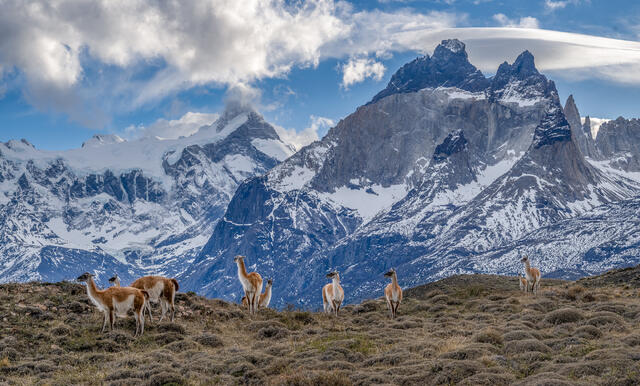
Quanacos on the Ridge
Patagonia, Chile
Guanacos is a camelid native to South America, closely related to the domesticated llama. They inhabit the steppes, scrublands and mountainous regions of the Andean foothills of Argentina, Chile and Peru. They are one of the largest terrestrial mammals native to South America.
Guanacos are herbivores: being both browsers and grazers. They forage for shrubs and graze on grasses, but will also feed on cacti, flowers, fruit and lichen. The lifespan of a guanaco can be as long as 28 years.
Guanacos live in herds composed of up to ten females, their young, and a dominant male adult. Unattached bachelor males form herds of their own. A newborn guanaco, known as a chulengo, can walk and keep up with the herd immediately. The dominant male will drive off its male offspring when it reaches the age of 6 to 12 months.
Natural predators of the guanaco include pumas and the culpeo, or Andean fox. Guanacos have thick skin on their necks which protects them from predator attacks. When threatened, a guanaco alerts the rest of the herd with a high-pitched bleating sound. The guanaco can run up to 40 mph (64 km/h), faster than any other Patagonian animal except the puma. This speed is important for the survival of guanacos because they cannot easily hide in the open grasslands in which they reside. Though typically mild-mannered, guanacos often spit when threatened.
Photo © copyright by Dr. Edward Mikol.
Photo Prints
Metal Prints
Acrylic Prints